

Liberals Are "The Left"
A narcissism of small differences in action

Part of my critique of “The Left” that seems particularly hard for leftists to understand is that I include liberals amongst them. But it comes from a fandom-driven narcissism of small differences rather than operating in a materially different paradigm from liberals.
In a previous piece, I asserted the divide between liberals and leftists is primarily philosophical. In reality, pretty much anyone who would call themselves a “leftist” is doing work for the liberal order in some way, even when (actually especially when) they believe they are not.

This piece was a magnet for very angry leftists. How dare I provide an actual argument for liberals and leftists being similar, rather than just being some right-winger who doesn’t know anything about “The Left.”
The piece was from January 7th this year. It continues to get comments from leftists every few days, angry that they are associated with liberals. A comment I got 5 days ago read simply “liberals are not the left.” I do not reply to many of these comments, but I wanted to get a little peek inside the mind of someone who was angry about a months-old post that isn’t just saying “damn liberal leftists and OBAMBA” or whatever:
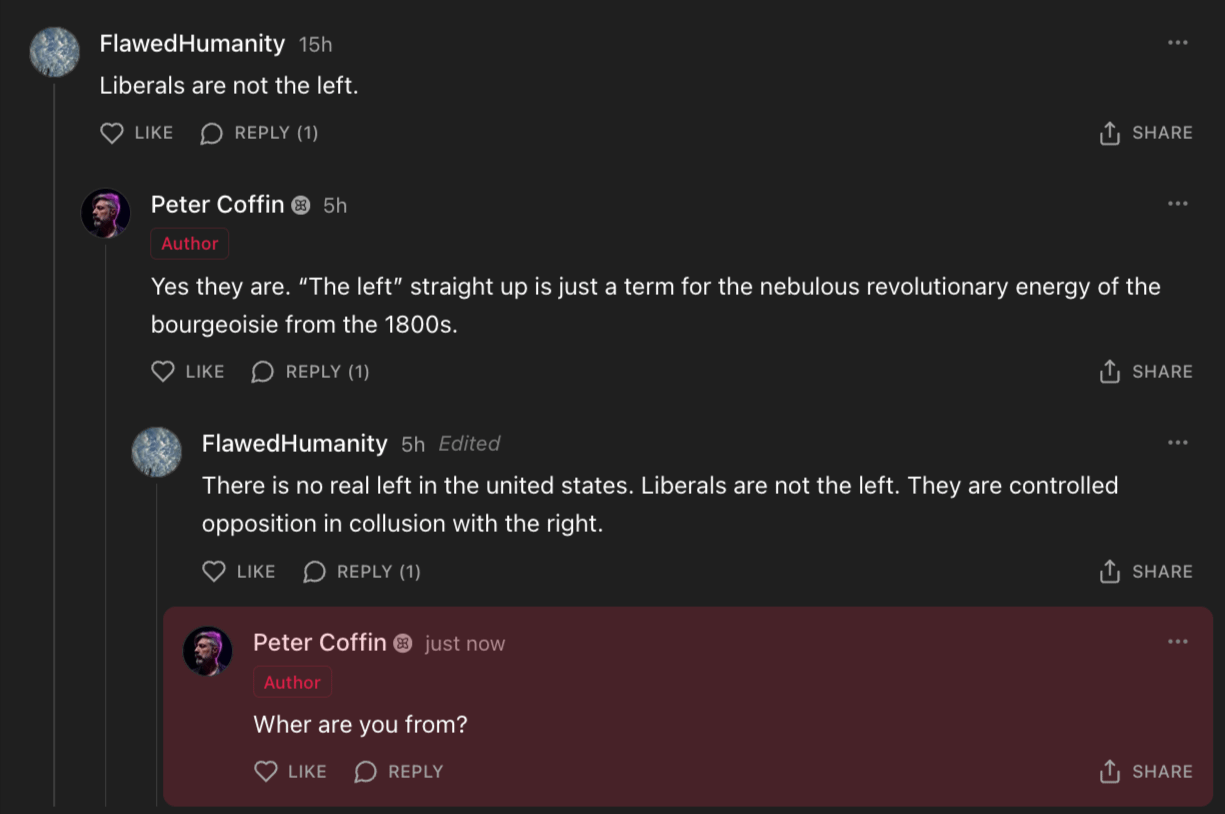
I gave a short answer that more or less covers what matters: “the left” is a term that arose from the French Revolution, when supporters of the bourgeoisie (the emerging class of capitalists) sat on the left side of the National Assembly. It was not a term for the proletariat, who were working under capital at the time, but for legislative officials who supported the capitalists.
To go a bit further, at the time, the capitalists were a revolutionary class! They were not the ones in control writ large, but they were gradually establishing practical authority over the proletariat as they coordinated their use of the machines they owned. That authority was the substrate for a takeover, and that’s how the capitalists became the ruling class.
While many believe “the left” is a movement for “progress,” the fact is, “progress” is a relative word. It does not note anything material, it does not make material distinctions, and it is therefore fungible in meaning. Meaning, at best, it is the revolutionary energy of the bourgeoisie disseminated among people who “want progress,” some of whom are fine with capitalism, some are not. This is not sufficient for making distinctions.
While I went in more depth in this article, this kind of thing is not the response to “liberals are not the left” most leftists are accustomed to. His response to my comment was about how “there is no real left in the US, liberals are not the left, they’re colluding with the right.”
To me, only a person calling themself a leftist living in the United States would ever say this. Outside of the US (or more accurately, the West), politics is significantly less culturally organized around the liberal ‘left/right’ identity divide familiar to Americans. So I asked the person where they were from and they just deleted all their comments.
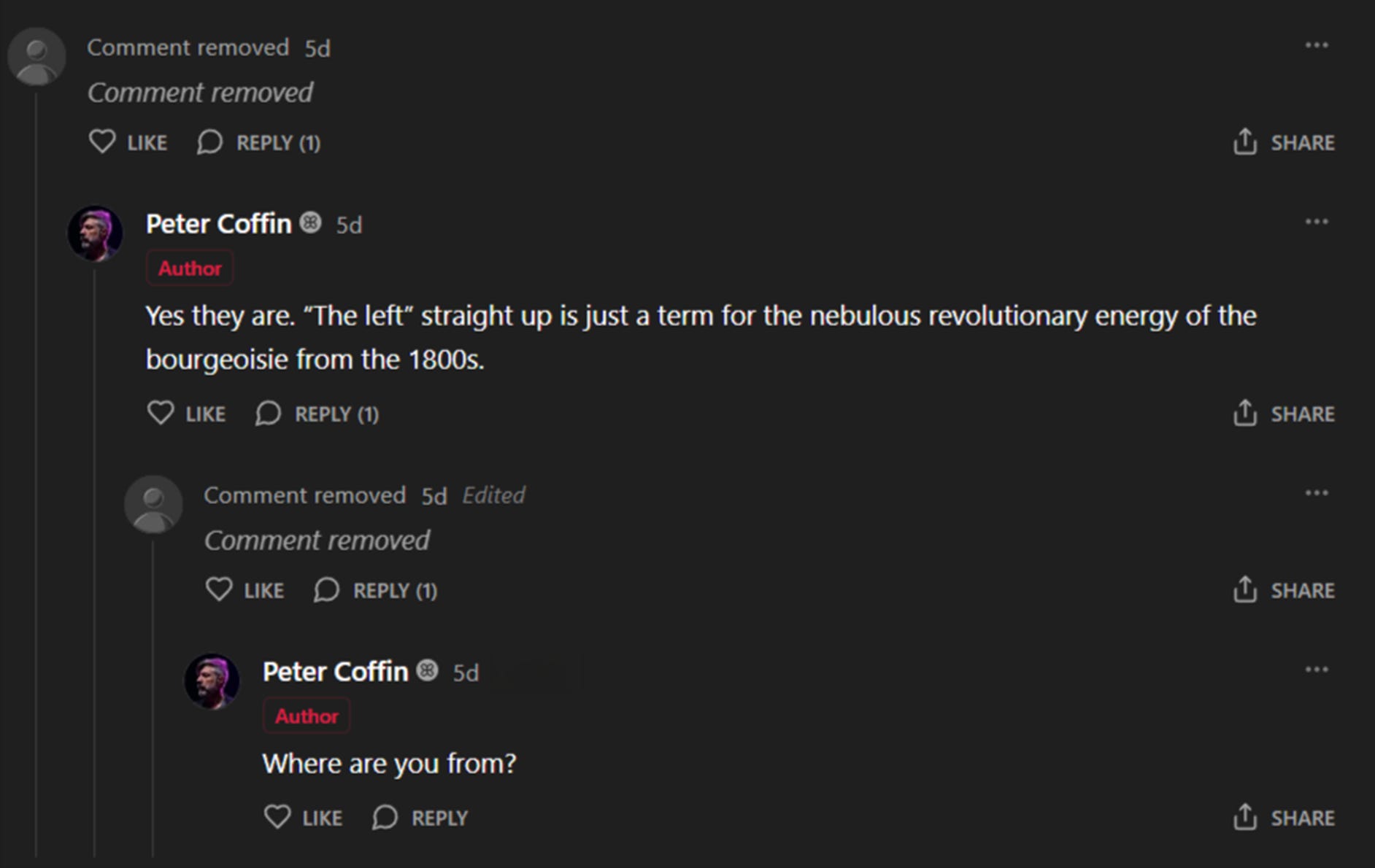
The framing only makes sense from within the American left, yet the commenter’s critique is positioned as external and corrective. The person saying “there is no real left in the United States” is almost certainly themselves a participant in the exact ideological culture they are attempting to diagnose from above (or at least appear to be).
That symbolic distancing is one of the defining behaviors of contemporary online leftism. The constant insistence that liberals are not “really” part of the left serves purely to preserve the category as morally coherent even when its history and practical outcomes become difficult to distinguish cleanly from liberalism itself.
People do not compulsively clarify that the gym is nothing like the bakery. That is to say, if the distinction were materially obvious, it would not require endless repetition. But “liberals are not the left” has to be reiterated constantly because the overlap is socially, culturally, historically, and institutionally obvious enough that the category requires continual purification rituals to maintain itself.
But “the left” was never a synonym for anti-capitalism (if anything, it was the antonym). As a term, it emerged from bourgeois revolutionary politics. Liberals are not some alien contamination that accidentally infected “the left.” Liberalism is foundational to the history of “the left” as a political category in the first place.
Liberalism is the “progress” it refers to.
But for many contemporary leftists, “the left” is no longer understood historically. It is understood morally (and as a fandom, consumed factionally in the same way Star Wars is). It becomes a category of personal legitimacy—of cred—and therefore any association with liberalism feels less like a political disagreement and more like an identity violation.
Capital-L "Liberal" is synonymous with the Democratic party in the states, unfortunately. Because so many people feel betrayed by the party, especially after what they did to Sanders, there's a desire to distance ourselves from it. "Liberals aren't the left" always read identically to "this isn't my party" to me. It's usually followed by "our politics are to the right of many other countries."
I think, in the US context, it can be useful. A frankly shocking number of Americans don't have any political awareness outside of the two parties. It gets out of the presupposed, especially Republicans who reflexively think anyone who disagrees with them is a Democrat. I've actually used the phrase myself when talking to my relatives and neighbors.
That being said, and for that very reason, a lot of Americans think their political ideas and lived experiences are universal. That I find more egregious, honestly.
I really am fed up with these label game arguments. They are beyond useless. Let's talk what you actually believe and want done and how you think of different individuals, situations, groups of people etc. Like do you want government power expanded? To where? Not expanded? To where? How should a government be structured? What room is there for society outside the state? What do you believe about tactics? Is rule breaking the State's law ever acceptable? Never? If never, how does that not basically amount to giving the elite the power they need? Are poor people at fault for being poor in a system as corrupt as this one? If so, how and how is that not to in some regard legitimate the system? What do we do with a system where wealth and power end up along racial lines? Should racial minorities be obligated to "assimulate" to a culture that has never given them good shrift historically or currently? Those are the kind of questions I need hearing and answers to and discussing more "left and right and other labels" label/flag games is irritating because I want to know MORE than that. I want to go BEYOND the labels. I want to know what are ACTUALLY BELIEVED, DEMANDED, AND DONE. Who the fuck cares if someone fits some label. I want to know what and how it will be taken if I say that I would rather have a system without the nation state. I want to know if you'd be there or ignore an attempt to build mutual care-based culture. I would want to know if you'd be willing to use disruption protest that actually was targeted at the right targets - like instead of blocking random people on Sunday and pissing off potential allies needlessly as a result, you directly blocked the streets to Palantir or BlackRock HQ or JPMC on Monday 9:00 AM. If I had the capacity to pull that off, would you be there or be lumping me with the "bad people" and thus thinning my crowd? Etc.