

There Is a Philosophical Difference Between Liberals and Leftists. There Is No Material Difference.

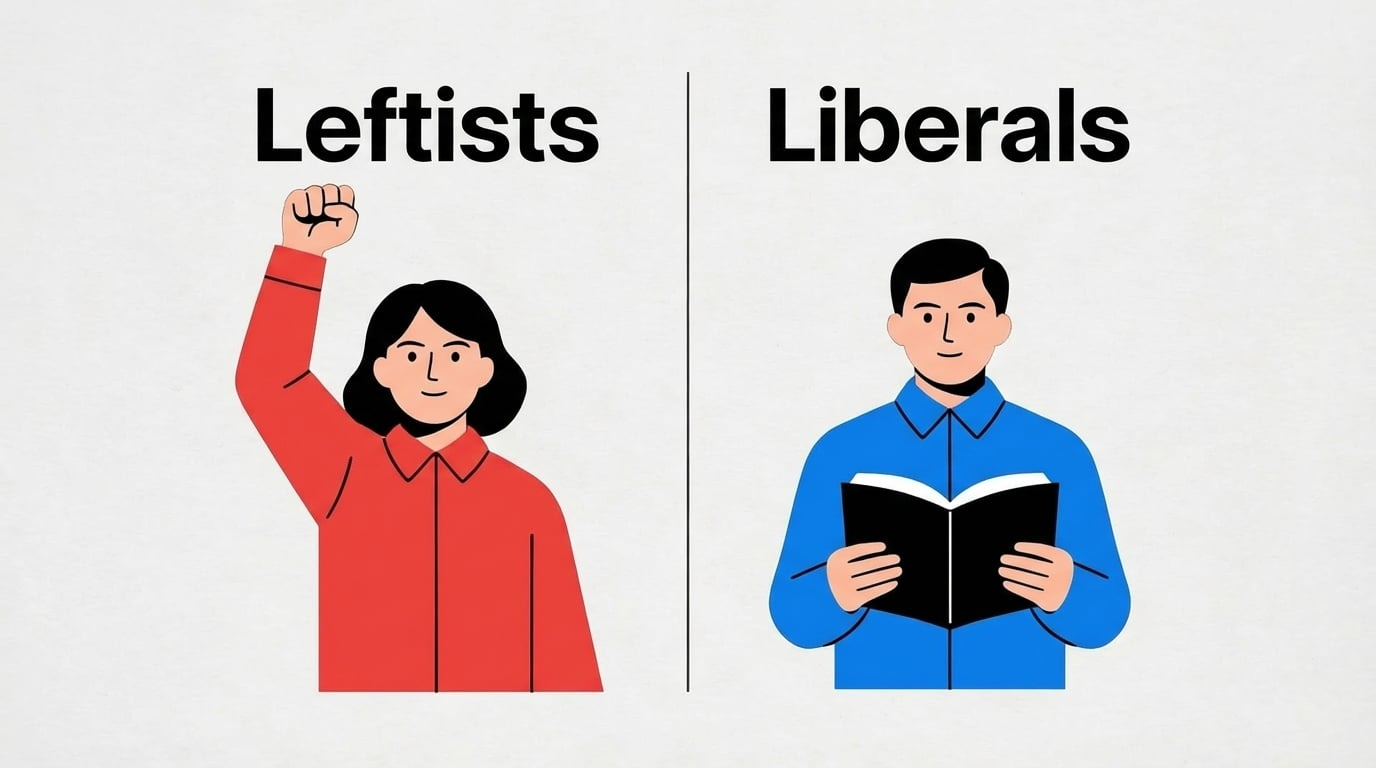
It is easy to explain the philosophical difference between liberals and leftists. Books (libraries!) are devoted to the topic. Any user of a social platform can have an algorithm endlessly reiterate the distinction, usually with the added reassurance that they have chosen the “good” side.
At the most basic level, the difference is straightforward. One position holds that capitalism can be managed and humanized; the other holds that it must be overcome. One emphasizes reform, the other transformation. One sees markets as neutral tools; the other sees them as systems of domination.
This ideological distinction is real. It is also irrelevant.
Because when we stop talking about what people believe and start examining what they do, the difference collapses. Philosophically, the gap is wide. Materially, it is so thin that it’s meaningless.
Sincerity and function are not the same thing. At the level of self-description (what people think, what positions they endorse, what lines they draw), we can say that leftists are not liberals.
But in practice, philosophical identity alone does not produce distinct material outcomes.
Expression Is Not Leverage
Politics does not happen at the level of belief. It happens at the level of behavior under constraint. Anxiety is a normal human response to material conditions, but people respond to that anxiety in different ways. Some pick their battles. Some attempt to fight every battle.
The idealist is more likely to act out the forcing of solutions, substituting intention, urgency, or moral clarity for leverage. The materialist, by contrast, operates through observation rather than prescription, understanding that conditions must be constrained before outcomes can change.
Neither liberals nor leftists are materialists. They differ in what they say should happen, but they respond to pressure in the same way: through expression, escalation, and (heavy scarequotes) “action.”
When confronted with constraint, both liberals and leftists default to the same repertoire: amplification, denunciation, and moral escalation. These behaviors feel active and oppositional. They register internally as “doing something.” But these “actions” are purely symbolic; they do not alter the conditions producing the pressure in the first place.
“But leftists often describe themselves as materialists! They can correctly analyze systems of power!” Materialism is not a vocabulary or a set of conclusions; it is a discipline of action. It requires patience, restraint, and an understanding that leverage accumulates only when behavior changes in response to constraint.
To enact some kind of material change, social integration and interdependence are prerequisites. Which isn’t to say “organizing” (or even “community organizing,” which “anarchism” has thoroughly colonized). In fact, I think the word “organizing” has become as useless a slogan as “abolish the family.”
Leftism does not create real social obligations (at least beyond simple compliance) or mutual reliance. Instead of material relationships, it substitutes shared language, shared symbols, and shared moments of outrage.
But leverage does not come from declaring opposition. It comes from occupying positions within systems such that withdrawal, disruption, or whatever action taken imposes a serious cost. That requires social density: relationships that persist, dependencies that are real, and roles that cannot be easily replaced or ignored. Without those, these actions are simply expressive.
“Organizing” is little more than coordinated expression. It is an activity that feels collective without producing interdependence. People show up, speak, post, march, and disperse (one might even find a like-minded date)! The system absorbs it and moves on; nothing is disrupted because nothing is held.
Liberal politics has always operated this way. It treats participation as pressure and visibility as leverage. The mistake leftists make is believing that sharper analysis or more radical language (see: looking down on liberals from a behavioral paradigm that is functionally the same) transforms this mode of engagement into something else. Either way, they ultimately think they are making a demand that the market must supply to them, which it cannot, does not, and will not. Attaching theory, regardless of how correct it is, doesn’t make it something different.
This is also why quantitative escalation becomes compulsive. When symbolic action fails to produce change, the response is not to alter strategy, but to intensify expression. VooOOte harder! OOOrganize harder! More urgency, more moral clarity, more declarations of crisis. Anxiety is released through engaging in activities rather than sitting with it and trying to understand it.
Material change, by contrast, is slow, often boring, and sometimes annoying. It would likely involve people being tied to one another in ways that introduce friction and require ongoing maintenance.
An argument I’ve heard many times against materialism is that it is deterministic. An argument I have heard against dialectical materialism is that it is purely about creating and encouraging conflict. I think these arguments are both short-sighted; yes, the conditions that determine our starting point are always there. Yes, there is conflict, but it was also already there; dialectical materialism observes rather than prescribes.
The human dynamism of choice is ever-present in what I have described, though: we choose to be involved, to accept uncertainty, to de-emphasize positions and preferences in favor of engaging with contradictions, and to be there for one another.
Dedicated liberals don’t do that, and neither do dedicated leftists.
Conclusion
The philosophical distinction between liberalism and leftism is cheap. It costs nothing to hold the correct theory, to use the right language, or to identify the mechanisms of power accurately. None of this, on its own, does anything.
A material difference occurs only when behavior changes under pressure, binding people through costs, obligations, and friction. When that isn’t the paradigm, we are only talking about self-description.
The difference between liberals and leftists collapses because their behavior is ultimately the same. It might exist in different quantities, but qualitatively, it’s the same. They engage the same systems in the same ways, release pressure through the same forms of expression, and retreat at the same points. Capital absorbs both without difficulty.
If material change is the goal, paradigm matters. These two groups are operating in the same mode.
Great stuff. I have some articles coming out on why leftists and liberals appear virtually the same to most ordinary people, and its in large part due to the similar socialization that they have. The voices who represent liberalism and leftism are cut from the same cloth, have a similar habitus, and have similar sensibility. The leftist is often just an unemployed or underemployed liberal. A precarious PMC
Very clear and persuasive argument. This hurt a bit, as one of those leftists who spends a lot of ink excoriating liberal politics, but in my defense I have always realized the general futility of "writing for change" and have maintained appropriate levels of self-loathing.
Kidding(?) aside, I can't speak for others, although I suspect this is common, but for me, sharpening my theory and critique is 1.) an effort to clarify my own thinking and develop strategies for putting words into action, and 2.) an attempt to build "organizing" / revolutionary capacity by converting more liberals and disaffected rightists.
Of course, the reality is that social media is largely an echo chamber, and while I know (based on feedback) that I have moved more than a handful of normies "left" over the years, getting people to sign the guestbook isn't going to automatically translate into the structured, sustained effort needed to surpass capitalism. I write because it plays to my strengths, not because I think it's the best, most direct way of affecting change. And I think many of us alienated intellectuals turn to writing as a desperate attempt to do _something_, to feel like we're moving the needle. And to keep at it, I think we all need to believe that moving the needle "matters," not in and of itself, but because there is a tipping point where the pressure becomes too great and change (or at least a challenge to power) inevitable.
Or maybe not. My current fixation is how power is becoming increasingly detached from popular legitimacy / will, a trend exacerbated by technology. But clearly, you _do_ need a critical mass of people who _do_ hold the 'correct' beliefs to have any attempt to challenge power, whether it's 5 million people or 100 million. The question is how many do you need, and what do you do when you have them? Do we have them now? And if so, what should we be doing? (This is rhetorical, and precisely what I'm trying to work out in my own writing.)
This piece of yours kind of hits at the philosophical utility of writing and persuasion. Obviously, authors can have tremendous impact (a certain Martin Luther comes to mind), but we seem to increasingly be in a world of power and propaganda* where facts and reality don't matter, nevermind political literature.** The question then is whether persuasion at scale can lead to social transformation, or if such change rests solely in material nodes of power. If the former, then convincing people that our outlook is good and true is necessary, no matter how slow or ineffectual. If the latter, then "writing for change" becomes a matter of the butterfly effect, hoping that the right people hold the right beliefs at the right moment.
*(Although, if propaganda works so well, this implies that counter-propaganda can too, although crucially the left lacks the reach and resources to combat right-wing and establishment slop at scale.)
**(Then again, you have the likes of Curtis Yarvin, another tally in the 'butterfly effect' column.)
Of course, real change probably requires both, but I sense some kind of irony that we're all here, largely writing about doing things instead of doing them, while trying to convince others what is, in fact, the right thing to do. And I'm not even saying we're wrong (or right) for doing so, but I wonder why we spend so much time thinking about what others think if it's not of crucial importance. Maybe we've only convinced ourselves that it is to justify writing instead of whatever it is we're supposed to be doing.
The last thing I'll say is that, again, even though it's just the echo chamber of social media, I have _never_ seen the word "revolution" tossed around so much in my life, along with direct denunciations of capitalism, along with disblief and outrage at the lack of action. This gives me a glimmer of hope. And I don't think you'd be seeing it without the years of work from countless writers just relentlessly hammering home the arguments, and then having reality confirm them. Again, this doesn't guarantee success, we get no points for "lots of people wanted the right thing," but it's not nothing. I'd rather have 50 million people waiting to be "activated" -- somehow, anyhow! -- than 30 million.
And I know "spontaneous uprising" or "spontaneous mass enlightenment" is not a strategy and a longshot, but as we who write, us cursed lot, it's always on the back of my mind. My hottest take is that we actually don't have time to "organize" (however you want to put it) the right way, and that simply priming people for action is the best we can (APPARENTLY) do right now, but that building that latent capacity might be unlocking possibilities we can't see right now. Unprecedented times may bring unprecedented times.
(Sorry this comment is a bit all over the place, your piece struck a nerve (in a good way).)