

Intentions and The Road To Hell
How Anti-Capitalism Often Ends Up Stabilizing Capitalism

“I’m just a soul whose intentions are good! Oh lord, please don’t let me be misunderstood!”
That line hits on something I think that all of us experience at some point: the desire to be judged by what we mean, not by what happens. We want our inner moral state to count for more than our effects. I do think intent matters, but generally that is in individual, interpersonal situations that can (and should) be resolved by talking with each other, like misunderstandings and screwing up. Even very serious situations that some assume cannot be resolved!
But that isn’t what I’m talking about. There are many situations, particularly political ones, where that instinct is not just wrong. In fact, politics without consideration of possible consequences often creates unintentional allegiance to interests that oppose our own.
The problem isn’t that good intentions are misunderstood. It’s that they’ve become a sorting mechanism for where political discomfort gets routed. Opposition to power is often treated as a destination rather than a starting point that demands further movement or new forms of engagement.
Because of this, dissent is often the most reliable support for the status quo.
“Intent Isn’t Magic” and Astroturf
The phrase “intent isn’t magic” is going to sound annoyingly familiar to a lot of people with any familiarity with the left. I don’t particularly like it (or any sloganized position), but it is, itself, a fantastic example of what I am trying to get at.
Interpersonally, people can and do cause harm without intending to. Good intentions do not prevent hurt, exclusion, or damage, and recognizing that was largely the original intent of this phrase. The insight was meant to interrupt the reflex to treat sincerity as infinitely defensible (if you know me, you know I consistently rail against this, too); wanting to do good does not guarantee that good was done. That is true, and it remains true.
At scale, intent matters even less. Institutions don’t care about sincerity or intentions. Political action doesn’t work because it’s righteous and good. A protest that imposes no cost is only expressive; a strike that doesn’t interrupt production is not a strike. None of this changes because the people involved believe good things.
I agree with all of this, but I hold strong disagreement with “intent isn’t magic.” All nuance was collapsed when this slogan became commonplace. Rather than a warning that, without thinking actions through, unintended harm is more likely, it became a rule that whatever someone intended doesn’t fucking matter, you piece of shit.
A useful parallel is the way “colorblindness” became taboo. Interpersonally, treating people equally without special attention to their race is often good and should not be controversial. Institutionally, however, “colorblindness” has functioned as moral pablum, an alibi that allows structurally racist outcomes to persist while those responsible reassure themselves that race played no role. The problem was never the interpersonal instinct. It was the institutional use of that instinct to absolve power.
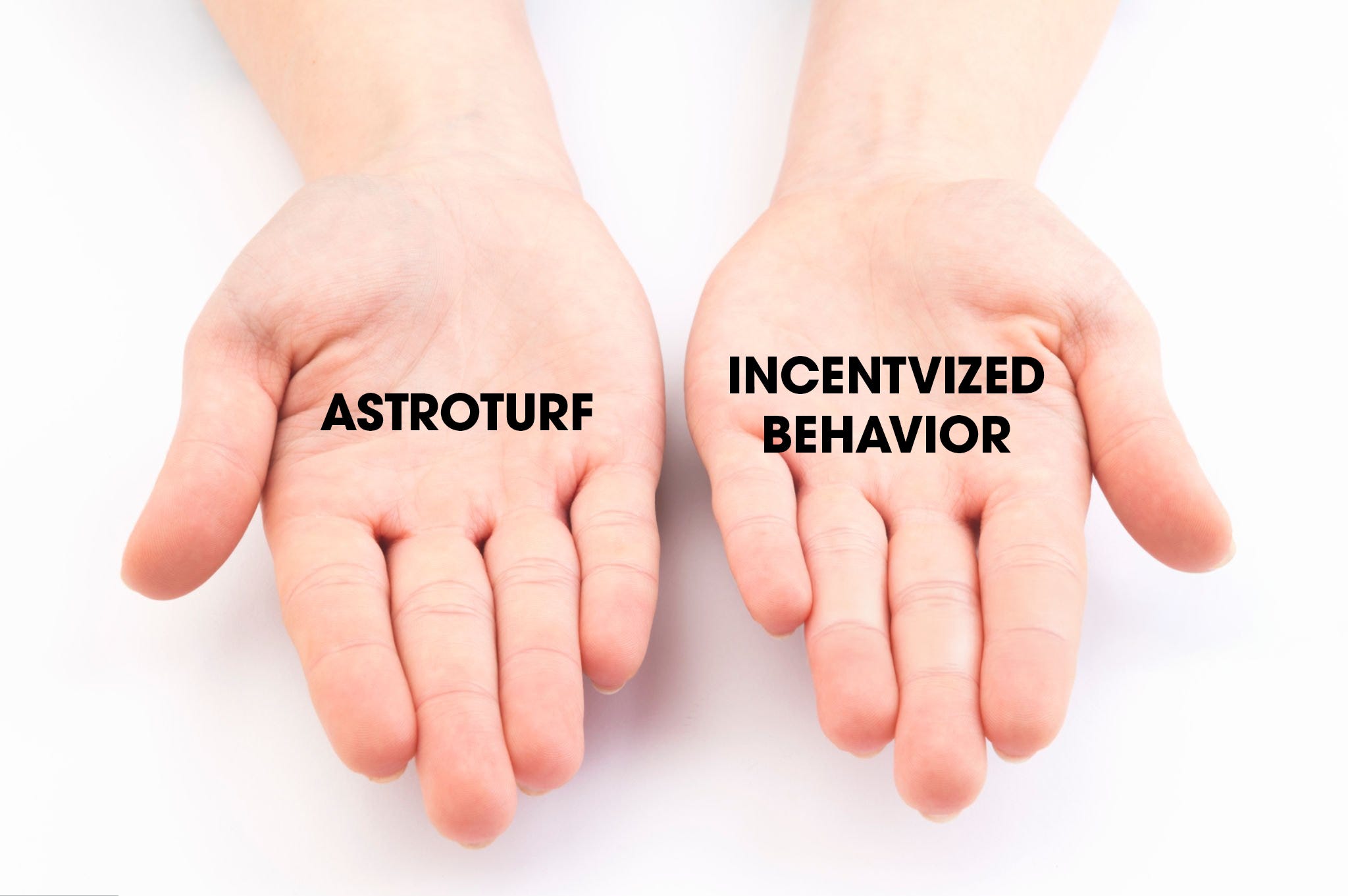
At a certain point, the phrase crossed a threshold. It stopped helping people think and started telling them how to act. A harm occurs, intent doesn’t matter, and enforcement follows. The phrase now serves as authorization for punitive behaviors. That is how it began to function as astroturf.
The political term “astroturf,” originally from artificial grass on football fields, describes actions that seem grassroots and genuine but are actually carefully promoted and supported because they lead to safe, system-friendly results.
Astroturf is typically employed to talk about lying. Wikipedia defines astroturfing as “the deceptive practice of hiding the sponsors of an orchestrated message or organization to make it appear as though it originates from, and is supported by, unsolicited grassroots participants.”
I believe it's a mistake to insist that intent defines an action in a mediated environment as astroturf. Sincere actions that benefit, protect, or do no harm to the ruling class (or the system itself) can easily be contextualized and amplified. In fact, some of the most impactful examples of what we might call “astroturf” are completely genuine; they are astroturf in a de facto sense. The crucial factor isn't what individuals claim to believe, but how their behavior impacts the system once it disseminates.
“Intent isn’t magic” now justifies punishment without context or inquiry into power. It excuses attacking others and discourages accountability by ignoring the importance of understanding reasoning for learning from failures and harm. The phrase promotes denunciation, escalation, and certainty, discouraging repair or clarification, reducing complex situations to harm, no intent, and punishment. Although it looks like material thinking, it’s really about individual morality.
In that sense, the slogan didn’t just lose nuance; it was the slogan’s propagation that actively removed it. It made judgment automatic and frictionless. And because it justified endless individual (read: downward, class-wise) enforcement while leaving institutions untouched, interests converged. This was always going to be pushed by the BuzzFeeds and HuffPosts of the world, which mined Tumblr in the late aughts to the early ‘10s for content they could use to advance their agendas (both political and traffic-oriented).
It’s annoying, but the phrase itself is an example of what it originally intended to communicate: it had its own unintended consequences and ultimately functioned as astroturf.
Choosing Not To Get It
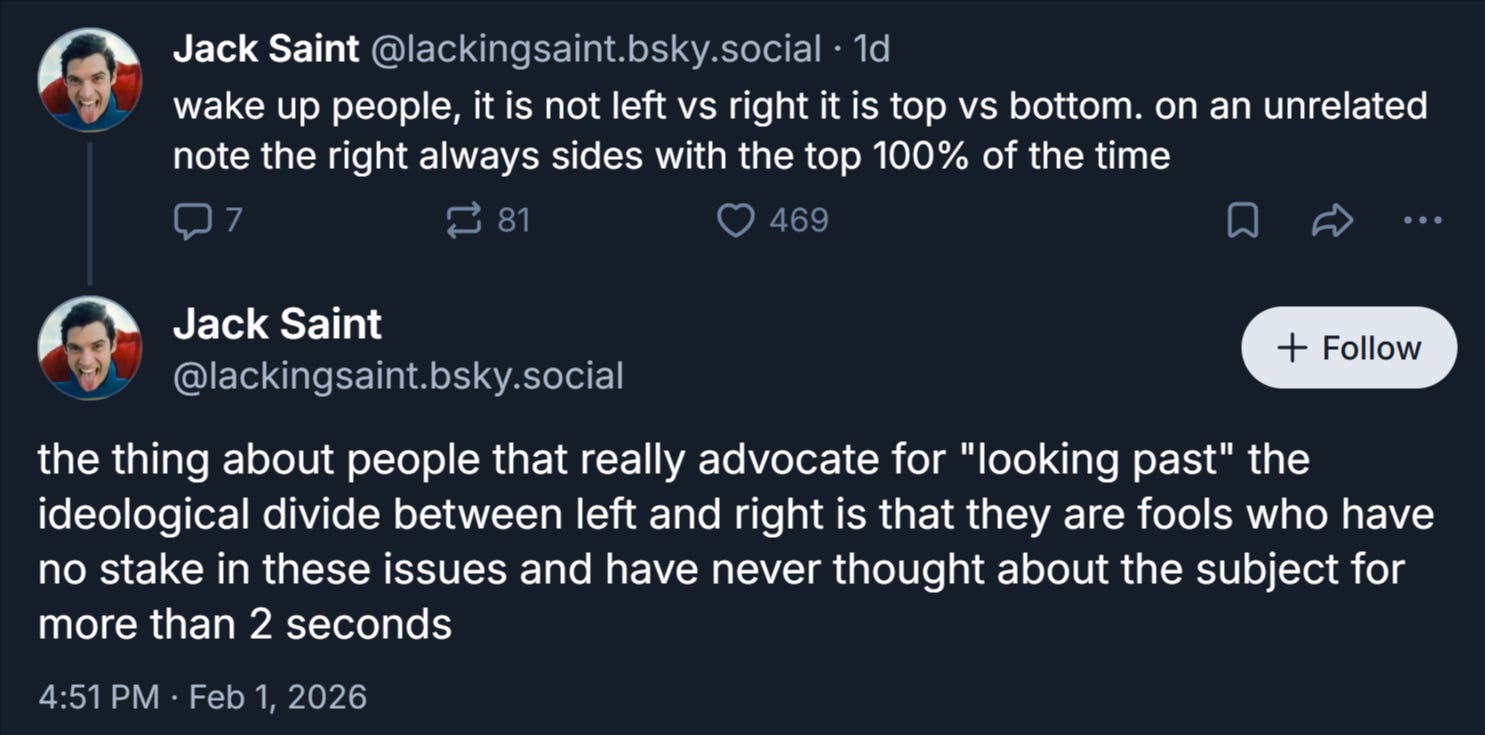
I was sent this bsky post as an example of Direction Brain in action, but it also shows exactly what I am talking about with intent: this is someone unintentionally engaging in astroturfing.
wake up people, it is not left vs right it is top vs bottom. on an unrelated note the right always sides with the top 100% of the time
the thing about people that really advocate for “looking past” the ideological divide between left and right is that they are fools who have no stake in these issues and have never thought about the subject for more than 2 seconds
- Jack Saint
On its own, that opening line would be a meaningful break. It would raise questions about alignment, incentives, and outcomes that don’t fit partisan politics, requiring a look at mechanics rather than perception.
But the very next sentence reasserts the left–right frame. On an unrelated note, the right always sides with the top 100% of the time. The phrase “on an unrelated note” is doing ironic work. It signals that the opening gesture was not meant to be taken seriously. It’s a nod to an argument the audience has heard before, immediately followed by its dismissal.
The move acknowledges the critique just long enough to neutralize it, then snaps back to the familiar conclusion: left equals bottom, right equals top. Nothing actually changes. The dangerous implication, that “the left’s” activity itself might need to be evaluated materially, is never allowed to surface.
The follow-up post makes this explicit. He makes it clear that “looking past the ideological divide” (read: “centrism”) is what you are doing if you move away from talking about the (moribund) left/right paradigm.
Rather than analyzing anything, he’s signaling what should be considered acceptable thoughts and dismissing others socially rather than through debate. This is a containment move; the thought of a material paradigm/program unsettles a worldview in which having the right thoughts is treated as a political mechanism. Choosing to avoid deeper analysis, attributing the threat to the status quo to an already-hated analogue (“centrism”), and reassuring the audience that nothing essential is actually at risk.
Functionally, this is de facto astroturf.
Not because Jack is lying or because he’s working with anyone, but because the action he is engaging in consistently yields a system-friendly outcome that he and all content creators are incentivized to pursue, giving the audience ideological reasons to remain as they are right now. It discourages people from critically evaluating the very dichotomy it gestures toward abandoning. It redirects them back into their current political identity (“left”) and frames any alternative analysis as unserious.
That matters because, if I’m correct, then continuing to “go left” under current conditions will continue producing diminishing returns. Left-branded activity has already been metabolized by institutions. Its language is popular, its tactics are manageable, and its actions are symbolic. Recommitting to it but harder does not increase leverage; it increases energy spent on things that are not effective.
Jack senses something is wrong. That’s why the “top versus bottom” line appears at all. But following that thought to its conclusion would require confronting the possibility that left identity itself is no longer oppositional in a material sense. That’s a much harder thing to accept than the idea that the right is simply worse.
The result is an argument that feels “revolutionary” while doing reactionary work. It reassures people that the current political terrain already represents class struggle, that the existing axes are sufficient, and that failure to produce results is just the cost of a hard fight, not evidence of misalignment.
From the perspective of power, that’s fucking ideal.
It preserves the current situation while allowing participants to feel oppositional, engaged, and morally clear. It supplies the ruling class with a sincere argument for the present arrangement: if left and right already map onto bottom and top, then nothing structurally new is required. Just more of the same.
This post matters not because it’s wrong, but because it’s right enough to stop people from asking the next question. This is the problem with the left. and why they will be kept around, “signal boosted” for all eternity: because they understand there is a problem, visibly oppose it, and that’s that. If you question this, you’re the bad guy; you must be a fascist. Are you secretly a conservative? Do you hate black people? Why do you want trans people TO DIE!?
De facto astroturf can simply be a real opinion from someone who refuses to go for the material relationships. It stabilizes people at exactly the point where “against the system” doesn’t shift to any alternative paradigms, so it is compatible with people’s current situation.
Social media algorithms are designed to pump comfort and conflict into your eyeballs, and this accomplishes both: you are currently right, and this person questioning you is an asshole you have to fight against to remain right.
Starship Troopers, Brooklyn 99, and Satire
A discussion I got involved with, coincidentally after most of this post had already been written, was about Brooklyn 99 as “copaganda.”
There is no question that cultural products can reinforce the status quo. Of course they can. They are produced, distributed, and consumed inside it, and by people who mostly experience capitalism like weather: as something that exists and must be navigated, but not necessarily interrogated.
But not everything that reinforces the status quo is politically actionable in the same way.
Take the film Starship Troopers. Its intent is openly satirical, and its target is fascism. There are a million video essays about this film where it’s used as an example of “intent isn’t magic.” One could argue it’s actually a good example, too, as it has been embraced by people who miss or ignore its point entirely.
But Starship Troopers does not gather discontented people, explain their frustration, and route them toward a particular political posture. If someone takes it as “pro-fascism” and likes it for that, that isn’t the moment when they became “a fascist.” Nothing changes; that is what they like. Conversely, if someone understands the film and didn’t previously question the things it targets, the film might serve as a question mark for which the person might seek an answer, but it isn’t an answer.
The same is true of Brooklyn 99, The Office, and Parks and Rec. These shows are not instructions. They are not arguments. They are not pivot points. They are ambient cultural objects; they serve as wish fulfillment or sources of familiarity. They reflect how most people already experience many institutions: frustrating but ultimately just “how life is.”
Culture does not need to be intentional propaganda to exist comfortably with the system. Most ideology does not arrive as persuasion; it arrives as normality. Simply attacking that normality (“Brooklyn 99, that thing you typed in the YouTube search bar, IS COPAGANDA AND REINFORCES FASCISM!”) does not create leverage or open new possibilities. It simply enforces a critical posture downward toward people who are not operating within a critical framework in the first place.
What I’m trying to say is that politics does not happen everywhere ideology exists. It happens at the moments where discontent is directed. Thus, our point of interest is not simply “things that support, reproduce, or even just don’t attack the system.” That is everything; every time one buys something, one helps reproduce the system. Should we hold all consumers accountable for capitalism? No, and it would be a massive waste of energy to attack people for unavoidable activities that, even if they were individually able to stop engaging in, wouldn’t change anything.
Rather, our point of interest is where those who are already uneasy and motivated are given direction that feels right, earnest, and oppositional, but remains compatible with the system (intentionally or not).
🔥HOT TAKE:🔥 Jack’s post matters in a way Brooklyn 99 does not, despite the latter having a reach well beyond that of most leftist content creators.
Jack’s intervention functions as a container. It gathers people who feel something is wrong, validates that feeling, tells them what it means, and where to stand. It reassures them that they are on the correct side, thus that the existing political paradigm sufficiently explains “the sides,” and that any attempt to think beyond it is unserious or suspect. That is a pivot point; it actively routes energy.
A sitcom does not do that. A movie does not do that. Satire, even the best of it, does not do that, unless it presents itself as an answer to political frustration (in which case it is arguably no longer satire).
This distinction is why so much left critique ends up exhausted and ineffective. By refusing to distinguish between ambient culture and routing mechanisms, energy gets spent attacking artifacts instead of interrogating the places where direction is actually being assigned.
If intent doesn’t control outcome, then critique alone doesn’t either. What matters is whether something changes the direction of movement—whether it alters incentives, breaks containment, or opens space for genuinely different forms of engagement. Most cultural products do none of that. And pretending they do is not radical; it’s convenient.
The left’s obsession with policing images often functions the same way as the cultural artifacts it criticizes: it stabilizes people at a comfortable stopping point. You are right. No further movement required. Batman is a fuckin’ cop, man!!
Conclusion
Intent does matter, and it also doesn’t.
I keep emphasizing this distinction that is increasingly avoided: one between awareness and leverage. Here, that applies to ambient ideology and direct intervention. Elements that merely exist within the system hold less importance than those that actively create a pathway, particularly because if that pathway isn't specific and tangible, it leads us right back to where we started.
The road to hell I’ve been describing is paved with sincere insights and critiques that feel oppositional but remain safe, and with a politics that mistakes being correct for being effective.
So, in other words, every visible path we are presented with currently.
Incentives quietly direct us to do things we don’t think we’re doing in the name of what is right, and the result is more effective than straightforward astroturf, because the angry, defensive posturing that follows is completely real.
I admire how you've managed, over the years, to stay as calmly and rationally analytical as you have. It has helped me be less angry over the injustices of the system, and though I've work to do on that front still, I feel like the issues are not insurmountable. Thanks as always for the read, Peter.