

Would having a "Maximum Wage" do anything at all?
Yes, but probably not what anyone would want it to.

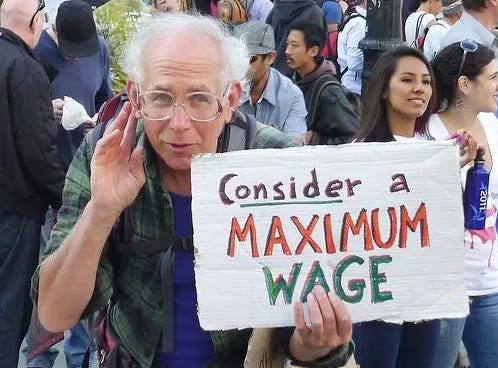
An increasing number of people are calling for a “maximum wage.” I understand why people would want this when the minimum wage doesn’t regularly increase and is not indexed to inflation. People's incomes seemingly are designed to stay stationary, but it’s worse; they’re designed to shrink along with the value of a dollar.
Many see an executive make millions of dollars annually and think, “That's not fair when I toil away to diminishing returns.” This is the impetus of progressive ideology attempting to provide an answer to the question, “Why can't I get anywhere?” However, along with every other ideology accepted at the mainstream level, progressive ideology exists not to challenge power but to preserve it. Progressive ideology does an incredible job of taking the concern of a system that is not working for everyone and redirecting it.
Thus, would a maximum wage change anything systemically speaking?
Envy
What to do about wealth disparities is often a heated debate, often mired in accusations of envy or jealousy. However, branding this issue as simply “envy on display” shifts focus away from the real issue.
It is typically a right-wing defense against someone advocating for regulation or changes in wealth distribution; “you’re just jealous you don’t have that!” Well, yes. Obviously. I do want that! It’s certainly better than what I have, which is less than that. From the right, the issue is that the left wants to take things from those who have already attained them.
However, leftists are also quite happy to deploy “envy” against an opponent. For the modern, pious leftist, people should not want more! Greed and growth are the problems with capitalism, not mathematical flaws or contradictions (or so they say).
Both perspectives ultimately see the system as workable, but We The People fail at it. For the right, too many people want more but refuse to work. For the left, too many people want more.
However, the problem is neither of these things; people want more because most don’t have enough, and even those who do have enough see the precarity of their situation and desire long-term safety. People would generally want to work (we would all like to be useful to society somehow). Still, enough people visibly work their asses off without getting anywhere that a culture of “work is bad” has arisen.
This predicament fosters a culture where work is devalued and perpetuates the belief that achieving success is futile – further, that success is a mark of the beast. But striving for wealth is not inherently negative. It can be, but simply wanting to improve one’s material situation is anything but “wrong.”
Fairness and Equality
The underlying pursuit here is “fairness,” an ideological trap. Marx asserted that each mode of production, be it feudalism, capitalism, or socialism, has its own concept of “fairness.” He believed that a “fairness” (or justice, right, etc.) propagated on a mainstream level could only be regarded as an ideology spread by the ruling class, thus, dismissed discussions about "fairness" as outdated and irrelevant. Along those lines, Marx and Engels eschewed the concept of “equality’ as an idealistic bourgeois aspiration.
Contrary to the belief of many contemporary leftists and/or conservatives, Marx was utterly disinterested in “redistribution.” In Critique of the Gotha Programme, he called it “vulgar socialism” and considered the whole notion to be “obsolete verbal rubbish.”
In response to the claim that society’s production should be equally distributed to all, Marx asked, “To those who do not work as well?… But one man is superior to another physically or mentally and so supplies more labor in the same time, or can labor for a longer time.… This equal right is an unequal right for unequal labor… It is, therefore, a right to inequality…”
Inequality is inevitable; people are simply not mass-produced to spec. This is regarded as a good thing when we talk about the collective ability to see the same thing in different ways. On that same line, we should embrace the idea that certain types of inequality simply exist without systemic impetus. We should seek to care for the vulnerable, but that can’t mean acting as though they are not vulnerable.
Thus, to attempt to distribute wealth uniformly is to disincentivize effort, which is not a desirable outcome. It is, ultimately, not “equality,” either, and would create a situation where people doing more work while getting “paid” less. This is exploitation and obviously not the point of “equality.”
To attempt to “make distribution fair” without addressing who owns the means of production is simply to set up a situation where the most willing and able are punished for being so (if the reader has dismissed this idea from a conservative, they’d do well to reconsider what the argument is even about).
Further, money and capital are not the same (especially in our era of fiat money). Money is a medium that facilitates transactions that simplifies the exchange of goods and services. Capital is wealth and assets used to generate more wealth through investment and production (meaning that money can be capital but isn’t by default).
What is it
Economics and politics are not merely about fairness but are fundamentally driven by dialectical power dynamics. While fairness (and justice, right, etc.) is a valid ethical consideration, the fundamental driving forces in these realms have nothing to do with it (and never will).
One of my criticisms of proponents of the “degrowth” movement is that they refuse to address ownership; their programs focus on redistributing wealth while conveniently never mentioning ownership. It is no coincidence these people receive large amounts of money from the capitalist ruling class. The reason this is such an important consideration is that ownership is power. To own is to control. Thus, to own the means of production is to control a society dependent on production (read: all society).
Marx’s “dialectic” describes interactions between opposing forces. The central concept of “dialectical materialism” is that the interaction between conflicting classes with differing interests shapes society. This manifests as the struggle between the capitalist ruling class and the subordinate/working class.
To illustrate my point, consider automation’s gradual implementation over the last century, fundamentally altering what labor is socially necessary. Ideally, automation would free people from unnecessary labor to work on necessary things. The fundamental problem with automation is not “taking jobs,” though; it’s who it serves. Due to the fundamental flaw in capitalism (the socialization of production while retaining private, feudal appropriation of the product), automation will only truly benefit those who own it (and therefore retain what automation creates).
So, let’s say we cap salaries at $50k. No one can make more than that. Great! But what happens when the necessity for most of the jobs as we know them today disappears? What happens when people start making no money? Even if a capitalist can only retain $50k, the difference between $0 and $50k is similar to that between $0 and $50b. To have zero means one can not do anything.
Then we must layer in the value crisis; a product's value decreases when its production process requires less labor (requiring fewer workers). Thus, the capitalist lowers the price but, to compensate, makes more of it to sell. However, the consumer purchasing power decreases quicker than the price (consumers were workers here), meaning the loop can never be entirely closed via consumer purchases. To say the least, this is a recipe for an individualist war of all against all that no one can win.
Money essentially becomes nothing; we would likely revert to trade because no one could earn money, which would likely devolve into human rights abuses due to desperation. To call a “maximum wage” merely putting a Band-Aid on a cut is to assume the Band-Aid is made of razor blades. It would technically be doing something, but that something only reinforces the problem.
Marx’s socialism is not that of today’s “left”; it is a scientific endeavor to find the core contradictions and flaws to resolve them and move to a higher stage of production.
Conclusion
While the idea of a "maximum wage" may seem like a fair solution to economic inequality, it fails to address the deeper power dynamics at play within capitalism. Merely striving for equality is not enough to fix the system, as it is merely an ideological trap used by the ruling class to maintain their control.
Redistributing wealth within the capitalist framework does not change the fundamental contradictions of exploitation and class struggle that Marx and Engels used to define the system. Rather than focusing on temporary solutions like capping wages, we must understand the need to transform the economic and political structures themselves.
Without reimagining how production and ownership work, implementing a maximum wage might provide temporary relief. In the long term, however, it will likely only worsen existing problems. To find real solutions, we need a material analysis of the contradictions of capitalism. With that, and only with that, can we strive for a higher level of production that fosters a society driven by shared prosperity.