

What Is Fascism?

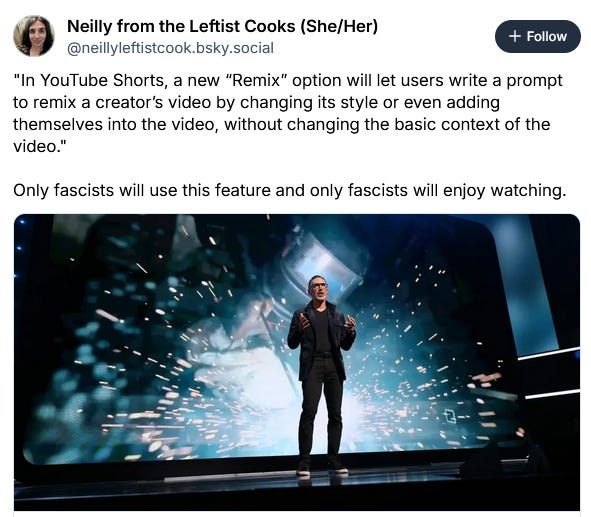
The other day, I was sent this screenshot of a person describing a new YouTube AI remix feature as “fascist.” Also, if you use and/or enjoy it, you are a fascist.
“Only fascists will use this feature and only fascists will enjoy watching.”
This is a problem that has gone on as long as I can remember. Fascism as a “you’ll know it when you see it” thing. The problem is twofold. Firstly, fascism is rooted in class contradiction and systemic crisis, and therefore can be materially described, but isn’t. Secondly, when we don’t constrain analysis to something specific and material, it begins to derive meaning culturally and individually… meaning relatively.
“I am a leftist! I am a revolutionary! The opposite of me is fascism! Thus, what I don’t like is fascist!”
A major reason for this is the popularity of Umberto Eco’s Ur-Fascism, which frames fascism less as a historical response to capitalist crisis and more as a loose collection of cultural and psychological traits. Without material distinctions, the question becomes “what isn’t fascism?”
Fascism As Aesthetic
To understand what fascism is, we must understand what it is not. Umberto Eco’s Ur-Fascism is probably the most influential text in modern liberal understandings of fascism. It is also, in my view, one of the most socially damaging.
I am not impuning Eco’s character; it would be silly to assert he was secretly pro-fascist or anything like that. His heart was clearly in the right place. I also don’t think the essay is entirely wrong. The traits he identifies have been seen in fascist movements, historically speaking.
The problem is that Eco treats fascism less as a concrete political response to material conditions and more as a recurring collection of psychological tendencies, aesthetics, rhetorical habits, and cultural attitudes. Fascism becomes something like a spiritual condition lurking beneath society, waiting to reappear whenever enough “warning signs” accumulate.
But fascism is a specific phenomenon, an arrangement of power within a capitalist structure, not a set of morals or aesthetics. Otherwise, is anything associated with emotional manipulation, irrationality, mass culture, spectacle, nationalism, technological mediation, conformity, or aggression “fascist”?
And that’s where the “everything is fascist” impulse comes from. But fascism is not a personality type, a cultural tendency, or a collection of bad opinions. It is a political response to a specific crisis within capitalism.
Eco’s first two traits immediately demonstrate the problem. His first trait is “the cult of tradition.” His second is “the rejection of modernism.” On the surface, these seem obviously true. Fascists constantly invoke ancient glory, national rebirth, sacred inheritance, mythic origins, and civilizational decline.
But if we examine the Nazis, the fascists, these traits are not straightforward. The Nazis were not simply anti-modern traditionalists. In many respects, they were techno-utopians. They worshipped machinery, speed, industrial power, weapons development, infrastructure, modern communications, aviation, cinema, radio, and scientific management. Their vision was not a return to premodern life. It was a technologically advanced racial empire.
Here’s the trick: there is no exclusive fascist aesthetic. A fascist regime can also say, “Why not both?” Fascism can appear traditionalist and modernist (to the point where the term “reactionary modernism” was coined to describe them) at the same time because its real function is not “tradition” or “anti-modernism.” Its function is counterrevolutionary capitalist stabilization through violence. And if our critique of fascism doesn’t denote specific material conditions, then we are overly concerned with maintaining our preferred culture. Which, as you know, is pretty good ideology for justifying fascism.
So Eco identifies recurring aesthetics, but those aesthetics contradict themselves because fascism borrows whatever symbolic material is useful. It can praise ancient Rome while building the Autobahn. It can denounce decadent modernity while fetishizing airplanes and rockets. It can indulge spirituality while organizing society through extremely modern bureaucracy, industry, and propaganda.
That does not mean fascism is impossible to define. It means aesthetics is the wrong place to define it.
Fascism As A Political Response
If fascism cannot be understood primarily through aesthetics, psychology, or cultural tendencies, then how should it be understood?
For that, I find R. Palme Dutt’s analysis far more useful than Eco’s. Under normal circumstances, capitalist societies are governed through liberal institutions. Elections are held. Rights are recognized. Opposition parties are tolerated. Labor organizations are permitted to exist. The state maintains legitimacy not primarily through force, but through consent.
This arrangement is not permanent.
When capitalism enters a period of severe crisis, and when large sections of the population begin questioning the legitimacy of the existing order, the normal mechanisms of liberal governance can begin to fail. Strikes increase. Political polarization intensifies. Revolutionary movements grow. The possibility of systemic change enters public consciousness.
At this point, the ruling class faces a problem.
If workers become sufficiently organized, they may cease demanding reforms within the system and begin demanding a different system altogether.
This is the context in which fascism emerges.
According to Dutt, fascism is not merely authoritarian government. It is not simply nationalism. It is not even merely political violence. Dutt wrote Fascism and Social Revolution in 1938, and broken down, this is a simplified explanation of the set of circumstances he put forward as fascism:
Capitalist decay or crisis
Legitimate threat of working-class revolution,
Monopoly capital/finance implements an open terrorist dictatorship
Collapse and radicalization of the petit bourgeoisie, terrified of proletarianization
Failure of social democratic constraints/institutions
Notice that none of these conditions are aesthetic. There is no requirement that fascists wear a particular style of clothing. No requirement that they worship tradition. No requirement that they reject modernity. No requirement that they be religious, secular, technologically enthusiastic, technologically skeptical, rational, irrational, or even internally consistent.
What matters is the function being performed. Eco’s list tells us what specific fascists looked like. Dutt’s framework tells us what fascism is. Once we understand fascism as a response to capitalist crisis, many of the apparent contradictions disappear.
Why were the Nazis obsessed with ancient myths while simultaneously celebrating modern industry? Because fascism was not fundamentally about either tradition or modernity.
Why could fascist movements invoke religion in one country and secular nationalism in another? Because fascism was not fundamentally about religion.
How can fascist movements adopt wildly different aesthetics from what is described in Eco’s list and still be fascist? Because aesthetics are not what fascism is.
“Preserving a culture” isn’t fascism; that’s one of many potential justifying ideologies for fascism. The purpose of fascism is to preserve a social order under conditions where liberal institutions are no longer capable of doing so.
So, instead of asking whether something feels fascist, we must begin asking whether the material conditions that historically produced fascism are present.
Why People Prefer Aesthetic Definitions
There is a reason aesthetic definitions of fascism are so popular. They are straight up easier because you can see them.
This transforms politics into a kind of cultural sorting exercise. The goal is then not to understand a phenomenon but to identify it, and thus inherently undermines itself because that understanding is what we truly need to identify it. It’s easier to ask whether someone is using the wrong language, has bad vibes or likes Attack on Titan?
This is one reason accusations of fascism have become so common and so disconnected from actual fascist movements.
If fascism is defined by a collection of aesthetics, then almost anyone can be assembled into a fascist through selective emphasis. The accusation becomes infinitely flexible because the definition itself is infinitely flexible. Thus, that which we don’t like and those who question us are fascists. They must be! And that means I am doing something important in using my limited time on this earth arguing with them on Twitter!
But if we cannot distinguish fascism from plain ol’ reaction, nationalism, authoritarianism, or even just technological change (as the person from the top of this post seems to think), then we lose the ability to actually identify fascism.
As with any other category, the oversensitivity desensitizes us. When an otherwise salient critique of something is punctuated with “because it’s fascist,” the valid parts of that critique become noise. Imperial-stage capitalism does not have to be at its worst to do things we consider brutal and wrong, and saying it is at its worst when it is simply louder and uses worse language (see: Trump) actively undermines one’s critique.
This is why I am so adamant on material descriptions rather than rhetorical definitions; many are wasting their effort in places where it will benefit no one, least of all themselves.
Conclusion
We define things by the characteristics that distinguish them from other things.
If two toilets are sitting next to each other and both are made of porcelain, there is no meaningful distinction to be made. But if one is made of steel and the other porcelain, suddenly we are talking about different things. Their properties differ. Their limitations differ. Their function differs.

Changing the color doesn’t do that. A red porcelain toilet might be considered visually offensive, but it is still porcelain. It weighs the same, breaks from the same force, and must be transported the same way. Functionally, it remains the same object.
The problem with aesthetic definitions of fascism is that they focus on the color. Maybe you prefer red toilets. Maybe you hate them. Maybe you think anyone who owns one is a bad person.
Maybe you’re a fascist!
The longer I've been alive, the more I think people use the term as a shorthand for "a person or group of people with 'the worst ideology', so when people are acting like fascists to these people, they are doing 'absolutely despicable things'.
But writing your incendiary tweet like that isn't helpful. That's not useful language, you just want to vent that people are doing things you don't like.
I’m sad at the missed opportunity to bring up Trump’s golden toilet because I really enjoy that factoid. Anyway, All aesthetic versions of fascism are quite hilarious. Like Karen is a fascist, and Andrew Tate, and Putin!