

The 1% Is Not a Class
The Met Gala is gross, but “you’re rich too” is not analysis

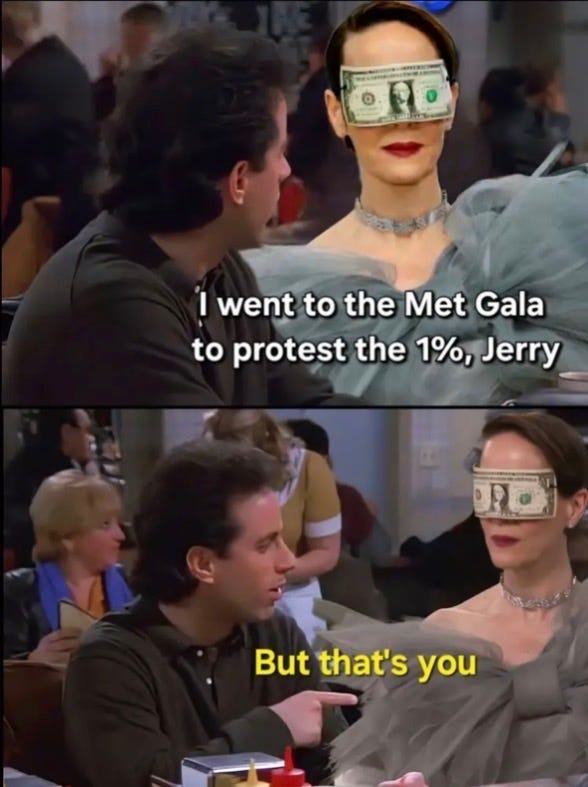
I find the Met Gala distasteful. It is a gaudy expression of wealth dressed up as charity (maybe “charity as fashion”?). It is the ruling class and its adjacents putting on costumes and asking everyone to pretend they’re doing something socially meaningful.
So when someone goes to the Met Gala and uses the event to make some kind of anti-capitalist statement, I do not have an urge to defend it. In fact, I think it is beyond useless. Like basically everything we associate with The Left, it is symbolic politics performed inside a machine that can absorb almost any gesture of dissent and turn it into content. The event does not get undermined by the protest. The protest gets venerated through the event.
But useless and hypocritical are not the same thing.
I bring this up because the standard critique of this kind of thing is just getting dumber than the thing it is criticizing. In the meme in the header, someone says they went to the Met Gala to protest the 1%, and the immediate response is, “But that’s you.”
As a joke, yes. Fine. The Met Gala is absurd. If you are there, you are almost certainly moving through spaces most people will never touch. You are at least “upper class” by normal quantitative standards. You are not exactly storming the Winter Palace.
But the critique doesn’t go anywhere, because “The 1%” isn’t a class. You can be in the top 1% of income, or wealth, or global wealth, and still not be part of the capitalist class in the Marxist sense. You might be highly paid. You might own an expensive house. You might be famous. You might have access to elite spaces. You might be rich by any ordinary definition. But that does not automatically mean your social power comes from owning capital and extracting value from other people’s labor.
In Marxist terms, class is not mainly about how much money you have. It is about your relationship to production. And it is not just “owning the means of production,” either, if by that people mean owning some stuff, owning a house, having investments, or even owning a business in some abstract legal sense. Uber can tell its drivers they are entrepreneurs, and legally, they may be sole proprietors, but they are not capitalists. They are not organizing production by hiring workers and extracting value from their labor (socializing production). They are workers.
A capitalist is not merely someone with assets. A capitalist owns or controls capital in a way that organizes/socializes production and profits from the labor of people who have to sell their labor to live.
Thus, a surgeon can be in the 1%. A successful entertainer can be in the 1%. A professional athlete can be in the 1%. A well-paid software engineer can be in the 1%. Some of these people may become capitalists; they are in a position to attain class mobility. Some may hire people for their business ventures, become landlords, invest heavily, or acquire capital and socialize production, thereby changing their roles. But the percentile itself does not tell you that.
The number tells you where someone sits on a distribution. It does not tell you their role in production. While capitalists certainly like to envision society as a leaderboard, there is a reason materialist class distinction (capitalists both own the means and socialize production) exists.
Marxist class analysis is not “rich people bad, poor people good.” It is not a moral sorting machine. It is about relations: who owns, who works, who commands, who depends, who extracts, who is compelled to sell their labor, and who is positioned to profit from that compulsion.
This is also why the standard gotcha about rich anti-capitalists usually misses the point. A rich person criticizing capitalism may come across as clueless or annoying. They may be self-indulgent. They may be laundering guilt through symbolic politics. They may be doing something completely ineffective. But it is not automatically hypocrisy.

I do want to make it clear I’m not defending rich people with a “you criticize society, yet you participate in society” argument. The Met Gala is not buying groceries, having a smartphone, paying rent, or otherwise simply existing inside society. It is an elite ritual of wealth, celebrity, access, fashion, “philanthropy,” and self-congratulation. Nobody has to go to the Met Gala. So when people react with disgust to someone making an anti-capitalist statement there, I understand the feeling.
My problem is that the feeling gets turned into analysis, and that “analysis” often provides catharsis, allowing that energy and care to dissipate.
That is to say, a rich person saying “maybe capitalism is bad” is not inherently dishonest. It may be clueless and certainly isn’t doing anything useful. They may even be laundering discomfort through aesthetics. But if they are accurately noticing that the world they inhabit is grotesque, that observation is not false. It might be kind of dumb coming from them, but it is at least possible that it is sincere.
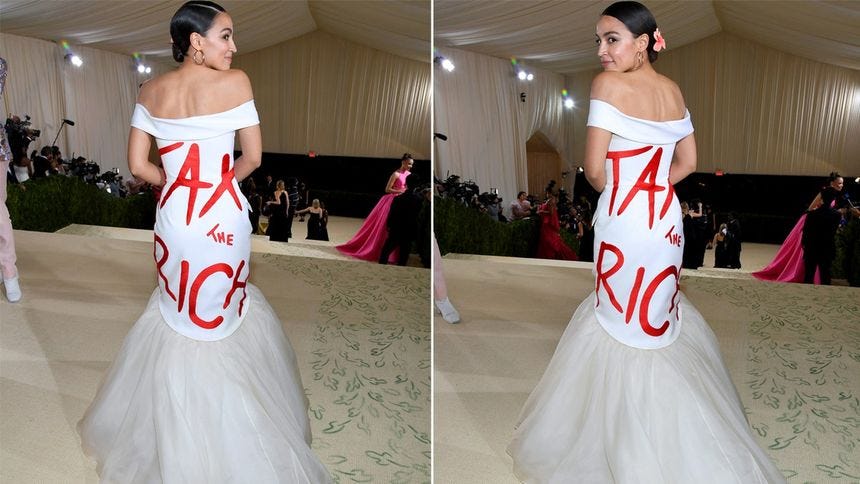
Someone like AOC wearing a Chick-fil-A-ass-looking “Tax the Rich” dress bothers me much more than some random clueless celebrity making an anti-capitalist statement. But the problem is not just that she attended an elite spectacle while saying rich people should be taxed. On its own, that is mostly embarrassing liberal theater. The deeper problem is that AOC occupies a position where she is treated as an avatar of socialism and class politics (or at very least was, and built her career on it—PACD called that one early) while, in practice, functioning as an impediment to them.
She did not have to be there. She chose to attend one of the most visible elite spectacles in American culture, then brought a protest message with her. But in that context, the message just reads as an excuse for being there.
A random rich person making a vague anti-capitalist gesture is one thing. A politician whose brand is “class politics” attending an elite spectacle in a slogan dress is something else. That is not just contradiction. I generated an image of Bernie Sanders doing the same thing and tell me it doesn’t illustrate my point:
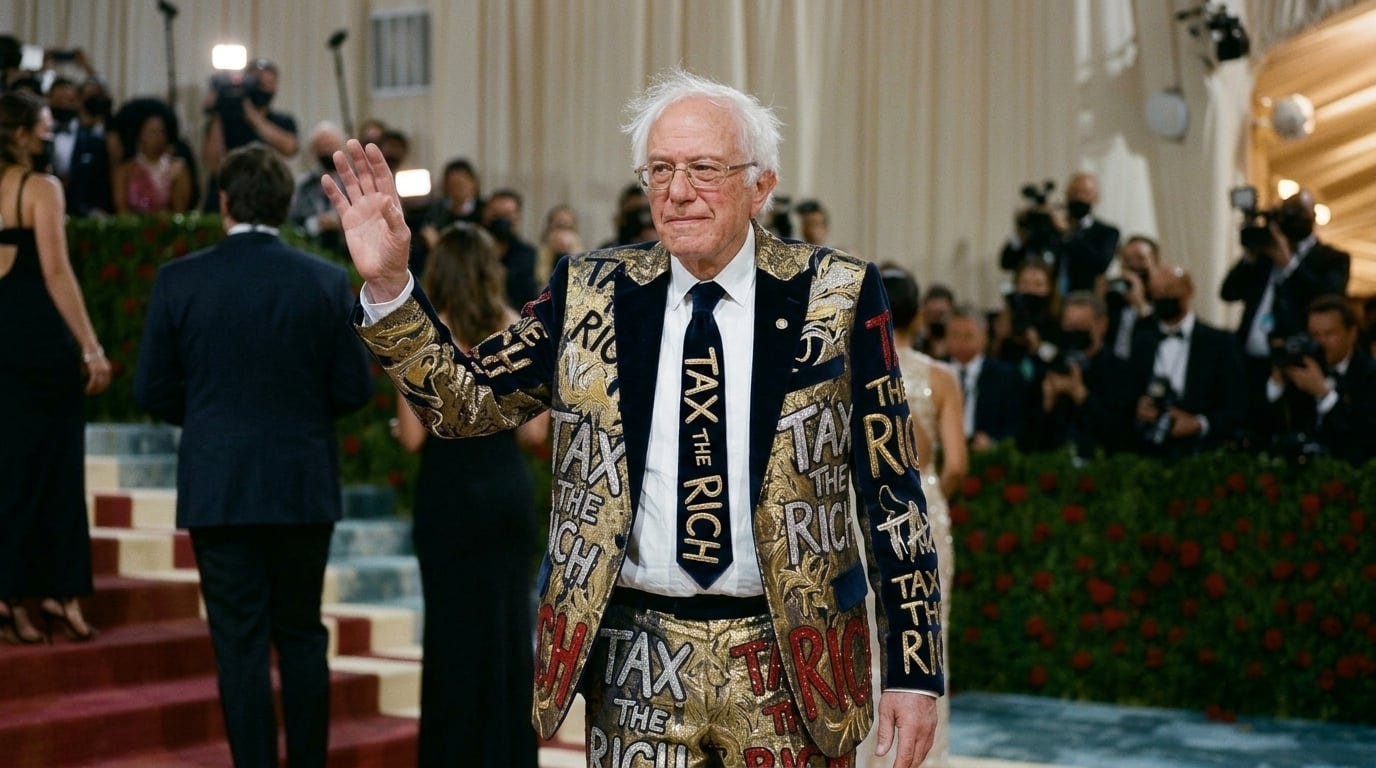
As an absurdist image, I find it extremely funny and had a good chuckle. But I am not going to pretend it doesn’t also make me just a little bit angry, even knowing it’s not real. Like, fuck that!
That is the problem with the Met Gala version of dissent. Not that everyone involved is personally lying (to others or to themselves). Not that no rich person can ever criticize capitalism. Not that a person above some arbitrary income threshold is automatically forbidden from making a class argument.
The problem is that elite spectacle has an incredible ability to metabolize opposition. It can take “Tax the Rich,” put it on a dress, run it through Vogue, turn it into discourse, and leave the underlying class arrangement untouched.
So yes, fuck the Met Gala. But also, no, “you are rich too” is not a serious critique.
Capitalism is not “when money or expensive dresses exist.” Capitalism is a social system organized around ownership, wage labor, accumulation, and the extraction of surplus value. The capitalist class is not “everyone above a certain income threshold.” It is the class whose power comes from owning and controlling capital.
That distinction does not make the Met Gala good (or make celebrity protest meaningful). Most “real” protests are genuinely absorbed by the capitalist structures and thus useless, so doing it at the Met Gala is less than useless.
But again, that is different from hypocrisy, which does actually matter, because quantitative class analysis produces idealist politics. If class is just a percentile, politics becomes a purity contest over who is allowed to speak. Where’s the line? What are the rules?

But if class is a relationship to production, the question changes. It’s no longer, “Is this person rich?” Instead, we’re asking what role someone plays in the system, what they are actually doing.
I want to see Bernie Sanders at the Met Gala in a tax the rich suit now.