



Depending on where you look, the US state has spent over $113 billion in “aid” (of various types) to Ukraine (Washington Post claims it’s less, and various estimates put it between $60b and $130b). Through Fiscal Year 2022, the US state has spent $8 trillion dollars on the post-9/11 wars in Afghanistan, Pakistan, Iraq, and elsewhere.
Meanwhile, in the United States, there are many problems that could be fixed with that money. But don’t dare point it out, lest one be called a Russian propagandist:
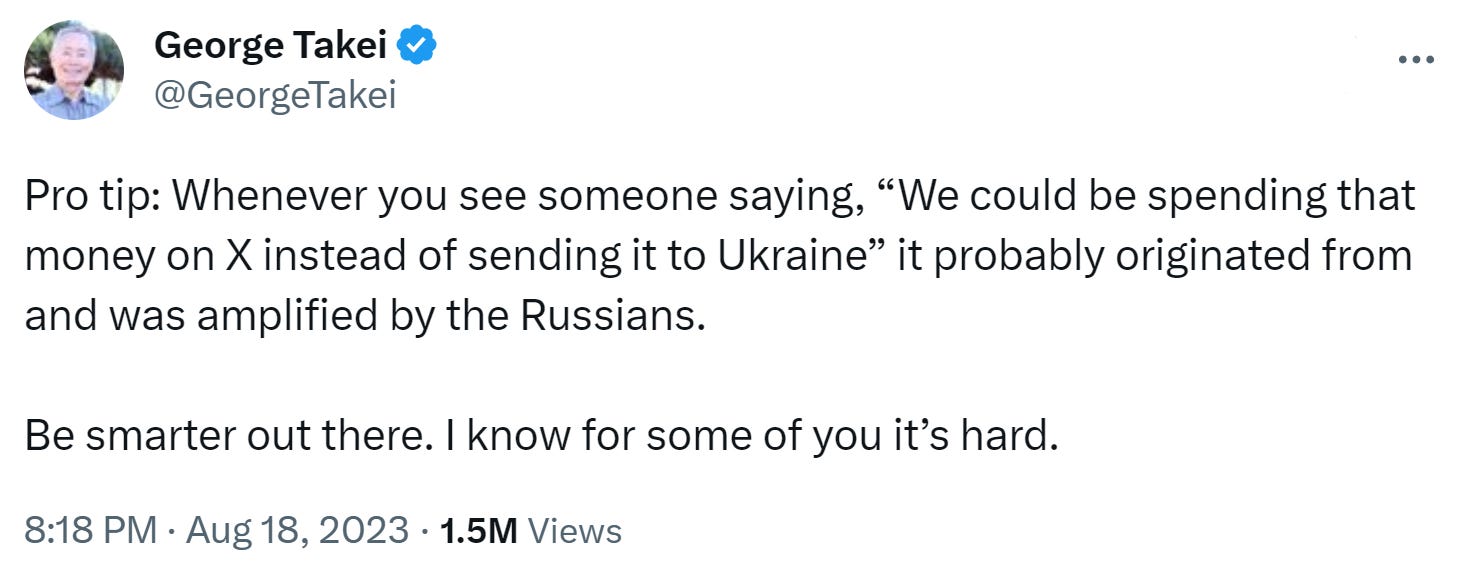
As people become more fed up with the US state, its sycophants have become more shameless and condescending. This attempt to suppress criticism by labeling it as propaganda only demonstrates how horseshit defense of our state has become. I love my country and its people, and I hate the bourgeois imperial state occupying it – terrorizing the rest of the world while people here drink poison water from lead pipes (that didn’t only happen in Flint, MI, by the way).
These apologists desire an environment where issues that don't impact them directly are silenced. We shouldn’t let them have it.
Problems Money Would Fix
A preliminary estimate for property damage in Hawaii after the wildfires is $1.3 billion. So, that shouldn’t be a problem at all. The US State has a shitload of money to flush down the Ukrainian toilet (as if that is the only military entanglement we have going, might I add…), so indeed, they’ll be able to handle taking care of our tax-paying citizens in Hawaii!
The Federal Emergency Management Agency encouraged survivors of the Maui wildfires on Monday to register with the government as soon as possible to receive a range of assistance, including an immediate payment of $700 to cover food and water.
The agency also said it is providing temporary housing in hotels and motels for survivors. And the Small Business Administration said it can provide a low-interest loan of up to $500,000 to homeowners for repairs and up to $2 million to businesses that suffered damage.
For survivors to get those resources, they need to register with FEMA through its smartphone app, on its website, by calling or in person with one of the agency’s disaster assistance personnel on the ground, officials said.
“FEMA Outlines Maui Wildfire Support as Victims Critique Government Response,” New York Times (8/14/2023)
People got pretty angry about the $700 payment. But, don’t worry, Biden apologists will quickly point out that $700 is the maximum FEMA can send without congressional approval. Biden supposedly cannot send more legally without going to Congress first! Except, after looking into it, I can’t find any universal limit for FEMA disbursements without congressional approval, nor can I find anyone official saying anything like this, including the Biden administration.
Further, I think the $700 payment isn’t even the big problem here. That isn’t possible to fix anything with. What I think is infuriating is homeowners will be given interest-bearing loans to fix property damage. An interest-bearing loan for $500,000 is not emergency aid; it’s for-profit finance. And it’s not just making these people pay to fix their destroyed lives; it’s charging them interest. The US state is setting up to profit from a natural disaster, and they’re calling it “relief.” I can only imagine what kind of a slap in the face that feels like.
Well, at least if they’re bringing in revenue, they’ll have a budget to throw at the following problems in the United States:
Infrastructure: Repairing bridges, roads, and public transport systems.
Healthcare: Ensuring more widespread coverage, improving care quality, or researching to find cures for diseases.
Poverty Alleviation: Programs could be developed to help elevate millions from poverty, focusing on affordable housing, job training, and education.
Education: Reducing class sizes, hiring more educators, and updating curriculums and facilities.
Technological Advancement: Funds could spur innovation in energy production, medicine, or even space exploration sectors.
Cultural and Social Programs: Investments in the arts, recreation, and community centers could enhance American life, fostering creativity and strengthening community bonds.
Wait… those things get neglected!? Biden has proposed $1 trillion in social spending cuts after announcing hundreds of millions more for war in Ukraine!?
Excuses
This is hardly a novel critique. As I said in the intro, the US has spent $8 trillion on war post-9/11, and many (from all over the liberal political spectrum and beyond) have made the observation that shit in the US is falling apart. From derailing trains to the fact we’re the largest national economy but have a private healthcare system with outcomes in the lower rung of the developed world regularly bankrupting citizens who do nothing wrong but get ill.
The obviousness of the critique doesn’t make it less accurate. Still, every time I have made it online, someone has appeared from the ether to say, “But if they stopped spending money on war, that doesn’t mean the money would go into important things” – an inappropriately directed “But who watches the Watchmen?”
No shit. The critique doesn't assume that if the US state stopped doing the wrong thing, it’d do the right thing. This point should go without saying, but is employed as a thought-terminating cliche, as if to say, “Yes, we know that is bad, but why say anything? Shut up!”
When one takes issue, they begin resorting to statistics. “But the money sent to Ukraine accounts for such a small fraction of the federal budget!”
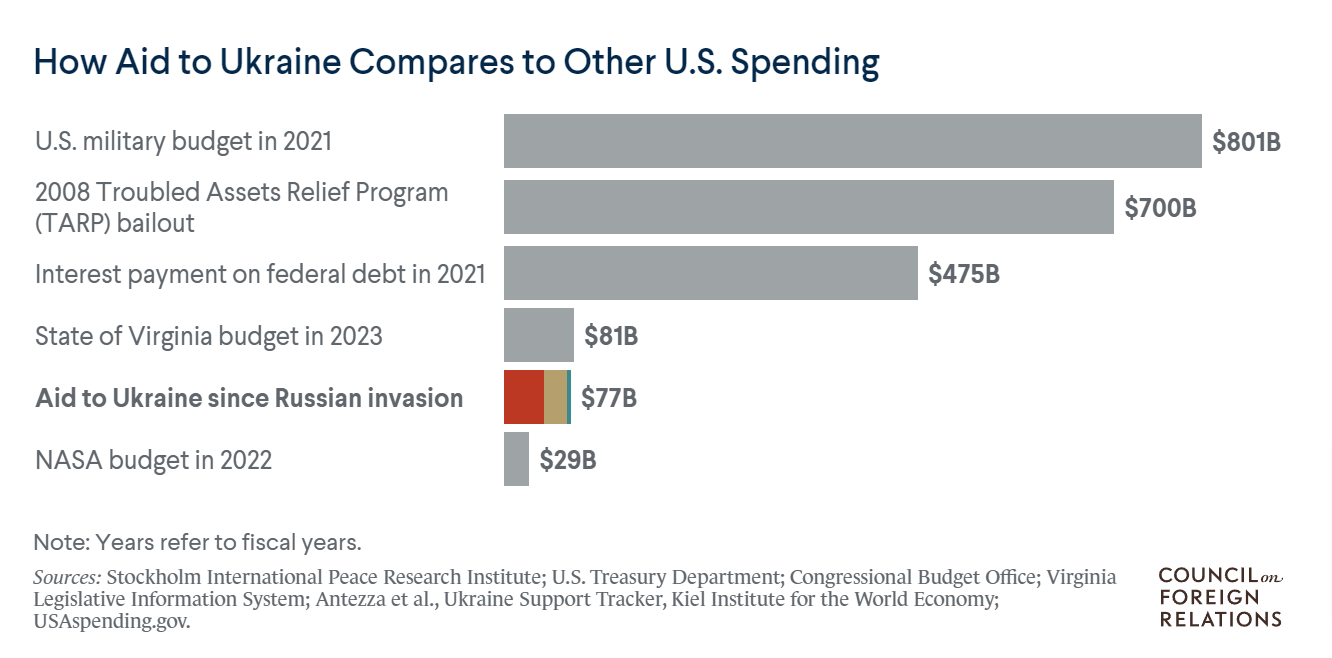
That doesn’t make it better! That makes it worse!
Responding to “many of the US's problems could be solved if they were using the money they’re spending on war" with “that's just a tiny fraction of the money” only compounds the issue! There is a mountain of money they are not spending on the American people’s problems!
Another irritating response is people saying, “The money’s not even real. They print whatever they want. They aren't taking it from Americans!” Sure, I guess. But the critique is not, “Fiat money is limited! This is a zero-sum game,” it's that the admin's imperial priorities are terrible.
However, this is by far the worst opinion, stemming from the “money is fake and therefore unlimited” argument:
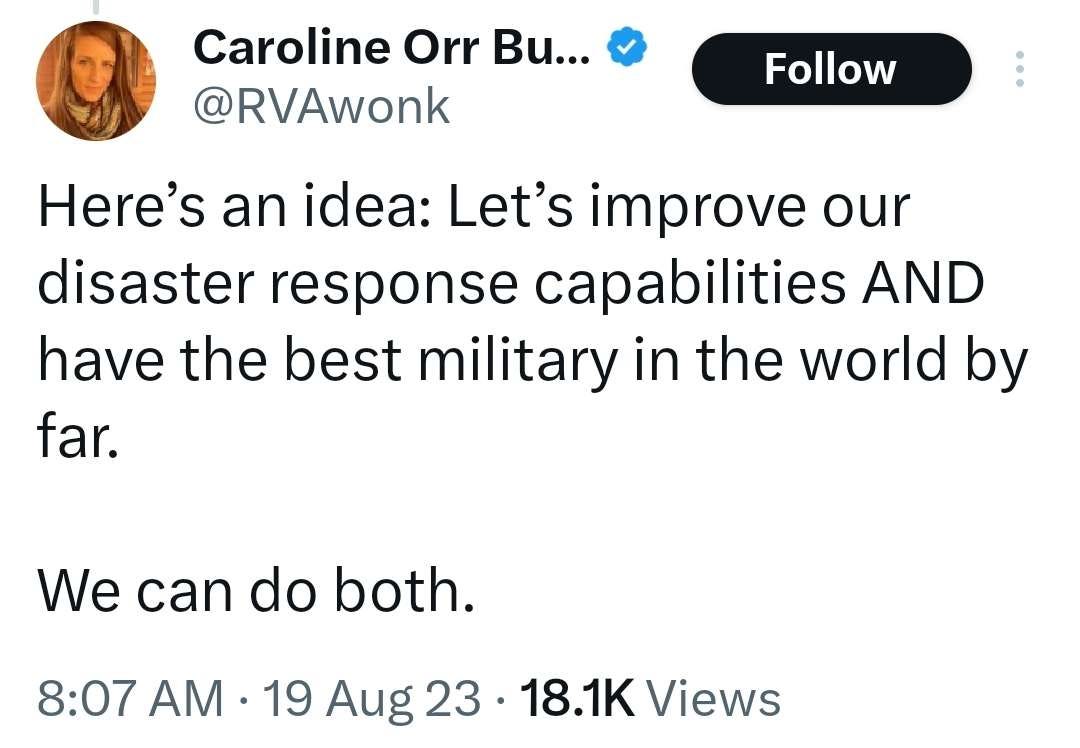
“We can #DoBetter with wildfire devastation AND mass killing.” Okay.
Priorities
To be blunt, the critique I am making is, “We don’t want war; we want a life that doesn’t suck.” We The People™ are not the ones being served by war, nor have we ever been.
When vast amounts of resources are channeled abroad for wars and interventions, it isn't merely a policy decision; it's a manifestation of the imperialist nature of the capitalist state. These endeavors are not about spreading democracy or humanitarian aid; they are the pursuit of geopolitical dominance.
So the real question is: Dominance for whom? Whose interests are being served?
The US state is acting, but not on behalf of its people. If it were, it would invest in infrastructure, education, healthcare, and the many communities in need. Instead, the capitalist state prioritizes the interests of the bourgeoisie, funneling money into wars and foreign interventions that further their economic interests. This isn't merely a matter of misallocation; it's a systemic issue inherent to imperialism.
Lenin’s Imperialism: The Highest Stage of Capitalism backs this point up repeatedly, but the aggressive imperial doormats work hard to keep our dirt off the US state’s boot.
Apologists for the state's imperial ventures employ mental gymnastics to justify their support, casting shadows of doubt and division. While they might even call out the fabricated necessity of these wars and claim to be against them, they don’t target the state that engages in them. Their real ire is reserved for those of us who even begin to say, “There is enough for we normal folk to live decently.”
Conclusion
To make this criticism isn’t to say, “If the US state weren’t bothering with Ukraine, things would be so much better for everyone here.”
It’s to say, “Look at the imperial machine’s priorities.” It’s a call to recognize where resources, time, and political will are being channeled and ask: “For whom? For what purpose?” The vast expenditures on war and foreign intervention are not mere oversights or misappropriations; they are material outcomes indicative of a system that puts capitalist interests above those of its citizens as domestic issues remain unaddressed.
If it is a problem even to identify the priorities of the imperial state, how might anyone expect to do anything at all? But that is the trick: these people don’t want to do anything. They want to feel good for knowing more and being more correct than everyone!
They assume that the critic is operating in the same liberal frame as them. But the goal isn’t just to divert funds from war to welfare but to reshape a system to prioritize human lives, dignity, and the collective good over profit, control, and geopolitical rule.
I appreciate this critique and think it makes a lot of sense. I'd like to know more, please, about the imperialist groups who benefit from us making war. Could you write more about that at some point? How does that work?