

Escalation Without a Base
Prote

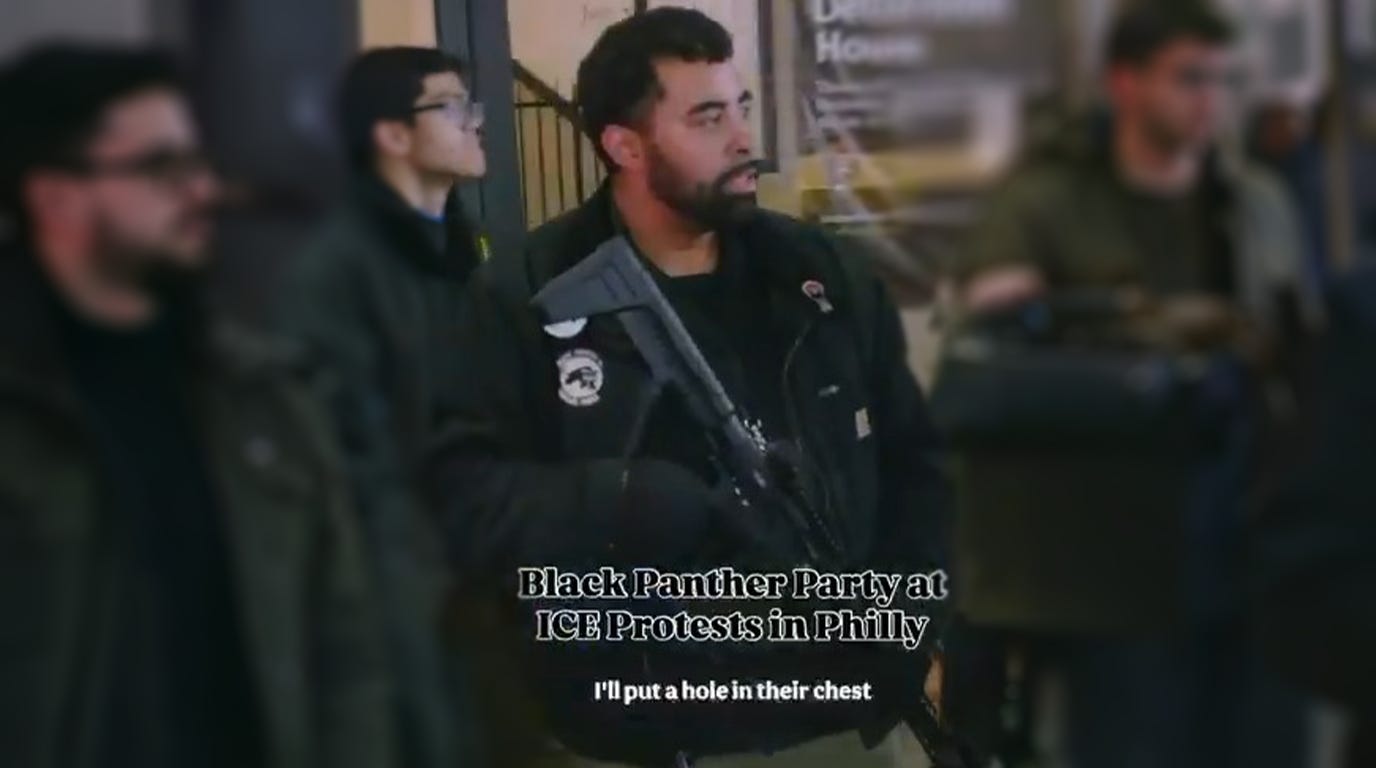
A short video has been circulating of a man identifying himself as part of a “new Black Panther Party,” openly armed and threatening ICE agents. He claims his group is “the same Panther Party from back in the day, but more aggressive now.”
The clip is being shared approvingly as a symbol of seriousness, deterrence, or resistance. But before taking a position for or against it, there’s a simpler question that almost never gets asked:
What is this action supposed to accomplish?
That question isn’t about intent, sincerity, or moral righteousness but leverage. And whether escalation, on its own, can produce power in the absence of integration, trust, or material dependence.
When you strip away the adrenaline, the branding, and the historical references, what remains isn’t a strategy but a familiar pattern, and one that defines much of contemporary “radical” politics.
What This Clip Actually Is
This man’s speech is not a strategy. It is a signal/symbol.
Won’t no ice agent ever run up on me. I guarantee you they won’t. I put a hole in their chest the size of a window! 🎵 Safelite repair, Safelite, replace. 🎵 That’s what’s gonna happen if they touch me. Unarmed woman was killed by ice. If you think you about to come and brutalize the people while we’re standing here, fuck around and find out!
Our interactions with the police and ICE? We hold them accountable. We hold them accountable. We patrol the community, and we hold them accountable. The Black Panther Party for Self-Defense. We’re the same Panther Party from back in the day, but we’re a little more aggressive now. You dig? Carry bigger guns and we don’t take no shit.
Places where there are a lot of immigrants at? I think that the community around them needs to take special care of them and needs to start escorting them to and from everywhere to make sure that they’re safe. Because them ICE agents ain’t gonna act like that if it’s a bunch of people standing outside with assault rifles and shotguns.
It’s a semi-automatic shotgun. That means them shotgun shells will shoot out of a pump? This shoots them rapidly. If you are gonna legally arm yourself, arm yourself with something bigger than what they got, those who serve in the public, they should be fearful of the public. They should be fearful that the public’s gonna be dissatisfied with their job that they’re doing, not feeling like they’re tyrants, not feeling like they’re bullies because they got guns and body armor and walkie talkies that makes them immune to whatever the people would do.
I think you wanna correct the ideology of the pig and the mentality of the slave catcher. You meet him with equal force. All power to the motherfucking people.
At face value, the speech presents itself as deterrence: a warning meant to prevent ICE action through the threat of force. And make no mistake, this man is carrying a large gun. Force isn’t out of the question. However, deterrence is something different altogether.
Firstly, it doesn’t matter how big this man’s gun is. It is nothing compared to the force of the US government. He says people should arm themselves with bigger guns than them?
Okay, just let me go grab my tank, my helicopter, my F-16, and all my drones…
Hell, say I actually have all that! Say everyone in my neighborhood does. And say that we’re all organized and disciplined. We could be torn through by the US state apparatus faster than that woman who was doing 100+ man bang marathons a year or so ago was tearing through men.
Deterrence only functions when it is backed by a credible, large-scale structure. But this is taking it at face value, assuming we need to execute deterrence correctly, and that means we need ot talk about how to deter. We do not. “Organizing” and “resistance” and all of this is horseshit. It is a social event and a spectacle. Whoever comes to an event like this is learning an ineffective method for change: expression.
This is performance… dick-wagging. But if it admits that, it really isn’t a problem. If you got a great dick, wag it all you want! Just call it dick-wagging!
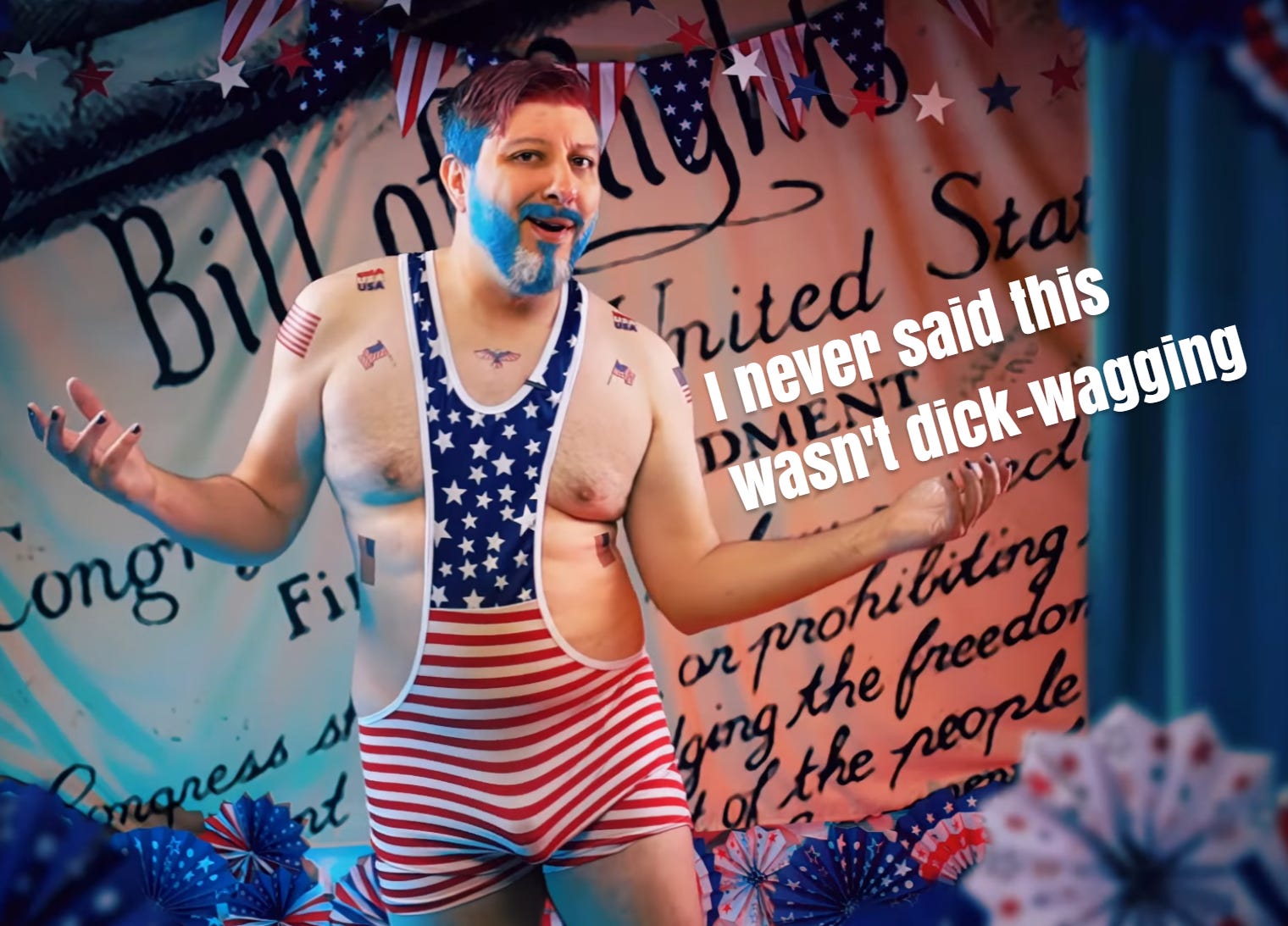
But this isn’t an example of that. This is a man claiming he is going around “protecting” people with a huge gun (not a euphemism, a gun). That claim is not just unserious; it’s dangerous.
This situation directly jeopardizes the individuals this individual claims to safeguard, because ICE is comprised of wannabe fascists motivated by a thirst for power, among others who are simply seeking substantial financial incentives. Neither group possesses adequate training nor a vested interest in de-escalation. In fact, arguably, the group that isn’t automatically bloodthirsty is acting more on concrete incentives to act as such!
And does it really matter when they gladly execute people with no rational justification? No!
But contemporary politics overwhelmingly confuses expression for power, so obviously it’s “important” to be out “organizing” and doing “real” things. What this speech delivers is not a plan, a demand, or a strategy for altering conditions.
This speech is a personal lethal threat that positions itself as political leverage through escalation and purported historical legitimacy. It’s optimized for two audiences. First, supporters, for whom visible willingness to escalate functions as proof of commitment and authenticity. Second, enemies, who are meant to feel provoked or baited into reaction (which is not good if you are supposedly protecting someone).
When one makes claims of deterrence (or any material effect), the fact that it is primarily made for an audience is telling. The assumption is that being visible is leverage. For social media success? Sure. Absolutely. But what does this clip accomplish? Does the viewer learn anything (other than how fuckin’ cool this guy is!!)?
No! They get the mild catharsis of seeing a cool dude say “fuck around and find out” about ICE, which is deservedly at a historically low popularity (thus an easy target for pandering), and they scroll to the next clip. The speech succeeds at one thing: it produces a clip. But without a base capable of translating risk into durable community integration, what looks confrontational in the moment is empty and dangerous.
The Black Panthers
When someone invokes the Black Panther Party, that comparison should be taken seriously. And if there is one thing I think is undeniable, it’s this:
The Black Panthers were not effective because they were armed.
They were armed because they were effective.

The Panthers did not walk neighborhoods yelling catchphrases (and not just the useless leftist ones, but Safelite’s corporate catchphrase) and calling it “protection.” What made them dangerous to the state was not their militancy itself, but the fact that they were socially integrated materially and locally.
They ran breakfast programs, fed people in countless other ways, and organized free health clinics. They read books with people and discussed their implications. They created cohesion in places where the state had abandoned people or actively preyed on them.
They built trust and rapport!
When someone says “we’re the same Panthers, but more aggressive,” what they’re really saying is that they think aggression was the point. The Black Panthers were armed from the beginning, but the guns were never the point. Those weapons were attached to a real, embedded base: a community that already relied on them, trusted them, and could absorb pressure. As the BPP itself understood, the power came from being indispensable, not from being visible.
Community integration is not optional. It is not a nice add-on. It is the precondition for anything resembling meaningful organization. You cannot skip it. You cannot replace it with vibes, rhetoric, or historical cosplay. You cannot compensate for its absence with bigger guns or louder threats.
YOU DO THIS BEFORE YOU DO ANYTHING ELSE. WITHOUT SOCIAL INTEGRATION, IT CAN’T BE ALL FOR ONE AND ONE FOR ALL.
Small groups do matter, but not to promote the cause. Marketing is for products. These pre-community organizational cells’ job is to do the slow, boring, unglamorous work of building relationships, trust, and mutual dependence. Reading to people, feeding them, helping pay rent, giving rides. Showing up (and doing so consistently over time) creates durable social networks that can persist under duress.
Loudly marching down the street with signs does not matter until you do this! Social integration is what gives these (or any) acts leverage and/or legitimacy. Without it, “organizing” remains confined to small circles that mistake intensity for scale and commitment for capacity. Growth depends on attracting people who already agree on the purpose and think your methods are the right ones. This isn’t outward growth!
The original BPP understood this. That’s why they scared the state into infiltrating them (and, coincidentally, the state infiltrators egged them on to be more aggressive! Interesting, right?). They were woven into the social fabric in ways the state could not easily disentangle.
Stripped of that context, invoking them today doesn’t strengthen an argument. It exposes what’s missing.
Content Discourse: The Default Substitute
At this point, it would be easy to say the problem is ignorance, bad actors, or people misunderstanding history. But that doesn’t hold; this pattern reproduces itself too reliably. We need to stop understanding critiques like this as pointing at some sort of failure of character or intelligence. This is a description and critique of an ideological condition.
We live in a society that routes nearly every desire for meaning, belonging, and change through commodified content. To win, now, is to go viral.

Media mediates; it sits in between people. And thus, it can re-route people’s desires. When people want to matter, the way to do so in a mediated ecosystem is apparently to become visible. When they want community, they gather an audience (a fandom). When they want change, they create a #moment. These substitutes look and feel enough like the real thing to replace it.
This is why “starting conversations” has become the stand-in for altering conditions.
Yes, a direct, unmediated conversation is potentially valuable. These conversations create obligation, produce memory, and change how people relate to each other. When you talk to someone you actually know, in a shared space, over time, doing constructive things together, either for each other or for others, that interaction binds you together. It creates trust, expectation, and consequence (and specifically avoids trauma bonding).
What we are mostly doing now is something else: mediated conversation, or more specifically, discourse about content. This happens on public feeds, comment sections, timelines, and clips. It is not oriented toward building relationships, but visibility. It does not create dependency or obligation; it creates alignment. People signal agreement, take sides, react, and move on.
Content discourse feels collective and seems in motion. But it does not impose cost. It does not require follow-through. It does not bind anyone to anyone else. It produces audiences (fandoms), not communities.
But don’t mistake this for an “online versus offline” problem. Offline spaces are just as mediated, just as performative, and just as oriented toward visibility and signaling as online ones (and in many cases, online and offline are one and the same). Marches, rallies, panels, protests, and meetings can function exactly like feeds: people show up, perform alignment, experience catharsis (maybe slide into someone’s “DMs”), and disperse without creating lasting obligation or interdependence.
What matters is not the medium, but the structure of interaction. If an interaction is organized around being seen, recorded, amplified, or validated by an audience—whether physically present or algorithmically assembled—it operates as content discourse. In these contexts, what circulates is not relationship but performance: a video or experience (or both) designed to be consumed, discussed, and reacted to, rather than a form of engagement that binds people together. The presence of bodies does not automatically produce cohesion, and sensory intensity does not create leverage.
I’ll take a moment to direct you toward my recent documentary about the Joker movies because Todd Phillips is describing and critiquing this exact dynamic. My doc is a more fleshed-out, media-centric version of this argument (it also discusses Luigi Mangione, who is relevant).
The films show how visibility, attention, and fandom get mistaken for agency, leverage, and change, both by Arthur Fleck and by the people watching him. What he finds are substitutes for identity, community, and change that feel real enough to almost satisfy, but never become those things.
The clown "movement" coalescing around him is not a political base but rather a fandom; a commodified simulation of community built upon the consumption of a spectacle. The documentary (just as the piece you’re currently reading) is also just content (dick-waving). To be clear, I am discussing content! I am not claiming this isn’t that, though, and I’m not telling you it will accomplish anything on its own.
But the New BPP™ ICE clip operates entirely on that claim. It doesn’t initiate real conversation with the people it claims to protect. It doesn’t build relationships, trust, or interdependence. It’s just content for “radicals.”
This is not a failure of sincerity. It is a predictable outcome of an environment in which mediation sits between people at every step, a system they seemingly avoid interrogating at all costs. And because content discourse is rewarded (algorithmically, socially, emotionally), it becomes the default substitute for the slower, harder, unclippable work that really only matters to involved parties: integration.
Conclusion
So we’re back to the original question: what is this action supposed to accomplish?
If the answer is visibility, catharsis, or signaling, then it is accomplishing those things! But those things aren’t accomplishing much at all. Escalation without a base doesn’t produce leverage. It produces content. And content, no matter how intense, cannot substitute for cohesion, obligation, or capacity.
We Live In A Society™ that offers substitutes for everything that actually creates power: identity without relationship, community without obligation, movement without progress. Those substitutes feel real enough to satisfy, but they never become the real thing.
leftists on the ground need to watch their back (and front, and both sides). don’t assume someone from a foundation-funded org is automatically cool. younger ppl would be wise to take what you write to heart.
infiltration is a major problem in these non-tethered “movements.” the left would be smart to learn about how Jan 6 happened: how’d they communicate, who was tip-of-the-spear, who/what was behind the actions of the day, how’d they gain trust with normies, how innocent ppl were imprisoned, and how that served interests not aligned with their own.
there’s more brandon darbys in the world than we’d like to imagine.
We are at the cattle car phase -- "they" have destroyed small community organizing. Now we have the internet and delivery.
Yes, we should begin these things, it is not too late.
However, we must also defend ourselves from tyranny.
I see comments calling on MORE LAWS to outlaw guns.
Tell me, which of the 300,000 Federal laws is protecting us? Seems the law only matters if you mind.
Do you believe that if YOU were just convicted of 34 felonies the law would let you start your new job? Really?
I see unidentified masked men smashing in windows, without even knowing who the driver is. I see unidentified masked men pulling elderly men out into the snow in his underwear.
WHAT LAWS ARE PROTECTING THE PEOPLE?!
NONE!
Your message is to go quietly to your death? NO! To stand and WATCH as people are beaten and dragged off somewhere?
While some of these white guys are all doom and gloom *what can lil ol me possibly do* it's fucking odd how you have forgotten the third world nations that have REPEATEDLY defeated the "might" of US weaponry with donkey carts and a hearty "fuck you!"
Can't never could. Can't never did. Can't never would.