

Data Center Derangement Syndrome
How panic over AI infrastructure obscures the real questions of scale, ownership, and power

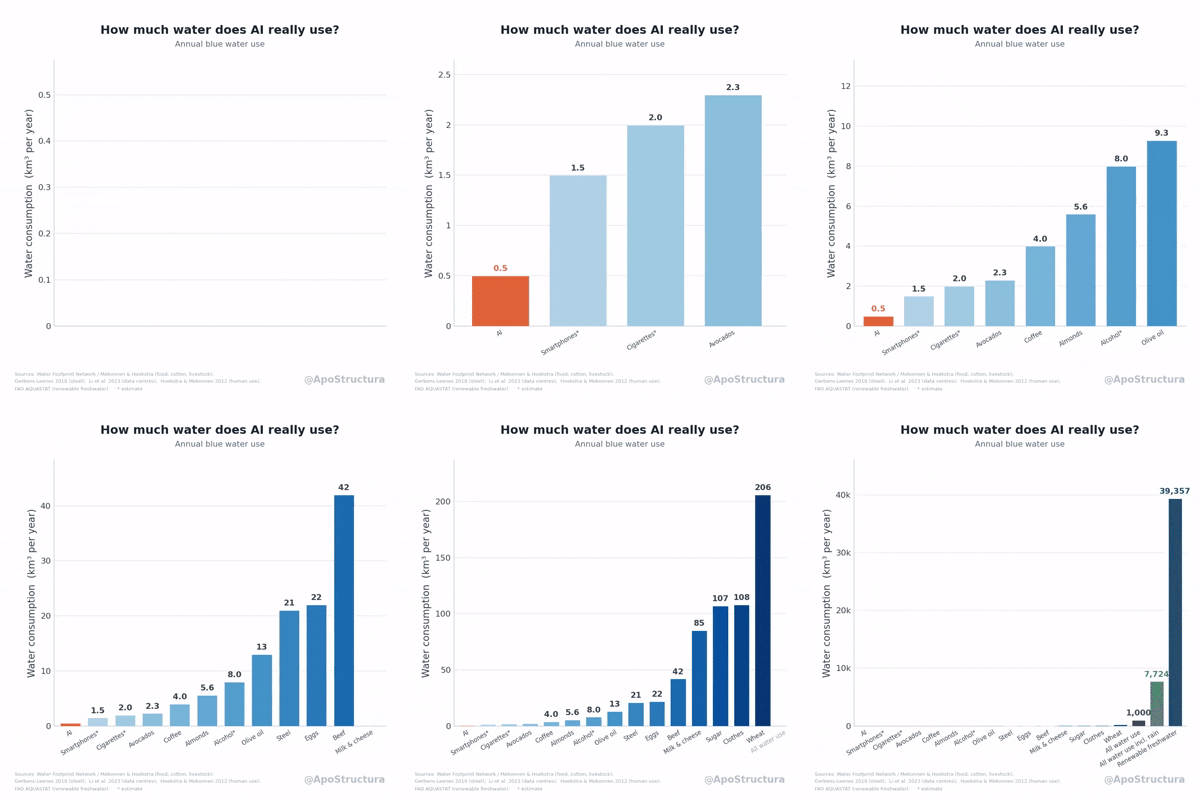
I saw a chart on Reddit comparing the estimated annual water consumption of AI data centers with several ordinary products and industries. I reposted it myself to my various accounts, thinking very little of it. I generally use social media in a broadcasting sense at this point, so I wasn’t really expecting to care enough about the response to say anything.
However, there were a massive number (well into the hundreds) of frantic replies, mostly pointing out that the data was “old.” Curiously, though, nobody responded by producing a newer estimate! I suggested to a few of them that they should do that, but as you might guess, no one did.
Rejecting Any Argument, No Matter How Well-Supported
The figures on AI water use were cited to research first published in 2023, which produced an immediate and remarkably consistent objection: the data was old. Data centers had expanded since 2023. AI had grown. Too much had changed.
Except 2023 was the publication date, not the year being measured. The figure in the chart comes from a projection of global AI water consumption in 2027!
The researchers estimated annual consumption of roughly 0.38 to 0.60 cubic kilometers, and the chart rounded the midpoint to 0.5, which I would say makes sense. I would personally take the high estimate to steelman the opposing argument, but 0.6 does not meaningfully change the chart or the animation’s point.
The paper was even revised in 2025 using newer reports and corporate disclosures, but its projected range for global AI water consumption in 2027 remained unchanged at 0.38 to 0.60 cubic kilometers. What was dismissed as a stale measurement from 2023 was actually a forward-looking estimate for 2027, based on research updated two years later.
Of course, this does not mean the estimate is infallible. AI infrastructure is expanding rapidly, and projections depend on assumptions about electricity demand, cooling systems, efficiency, and the composition of the power grid. A newer estimate could reasonably be higher.
But that was not the criticism people were making. They mistook the citation date for the estimate date and then treated that misunderstanding as sufficient reason to dismiss the comparison. Before anyone had established if newer evidence would meaningfully disturb the chart, a consensus had already formed that it must.
Still, projections can be wrong, particularly in a sector growing as rapidly as AI. So even though the objection was based on a misunderstanding, it is worth asking the underlying question anyway: what do the newest available numbers actually show?
The most recent estimate I could find concerns 2025. Research made available online in December 2025, officially published in Patterns in 2026, estimated that AI systems consumed between 312.5 and 764.6 billion liters of water that year, equivalent to roughly 0.31 to 0.76 cubic kilometers.
Taking the highest estimate available, as I said I would, raises the animation’s AI figure from 0.5 to approximately 0.76 cubic kilometers. That is an increase, but it does not meaningfully disturb the chart. Even using the upper estimate, AI still does not reach one cubic kilometer of annual water consumption. In other words, after hundreds of people insisted that explosive growth had rendered the figure hopelessly obsolete, the newest research I could find places present-day AI water consumption in almost exactly the same general range.
Even if the estimate were wrong by an entire order of magnitude—say, if AI consumed ten times the 0.5 cubic kilometers shown—it would rise to 5 cubic kilometers annually: above coffee, but still below almonds, alcohol, olive oil, steel, eggs, beef, and the much larger categories that follow. Even multiplying the highest recent estimate of 0.76 by ten produces only 7.6 cubic kilometers, still below alcohol and well below olive oil. The estimate would need to be wrong by roughly seventeen times before it reached olive oil.
This is not an isolated conclusion. SemiAnalysis attempted a similar exercise, comparing the blue-water footprint of one of the world's largest AI data centers with other ordinary activities. Their estimate was that xAI's Colossus 2 facility consumes roughly 346 million gallons of blue water annually, about 2.5 times the annual blue-water footprint of a single In-N-Out Burger location.
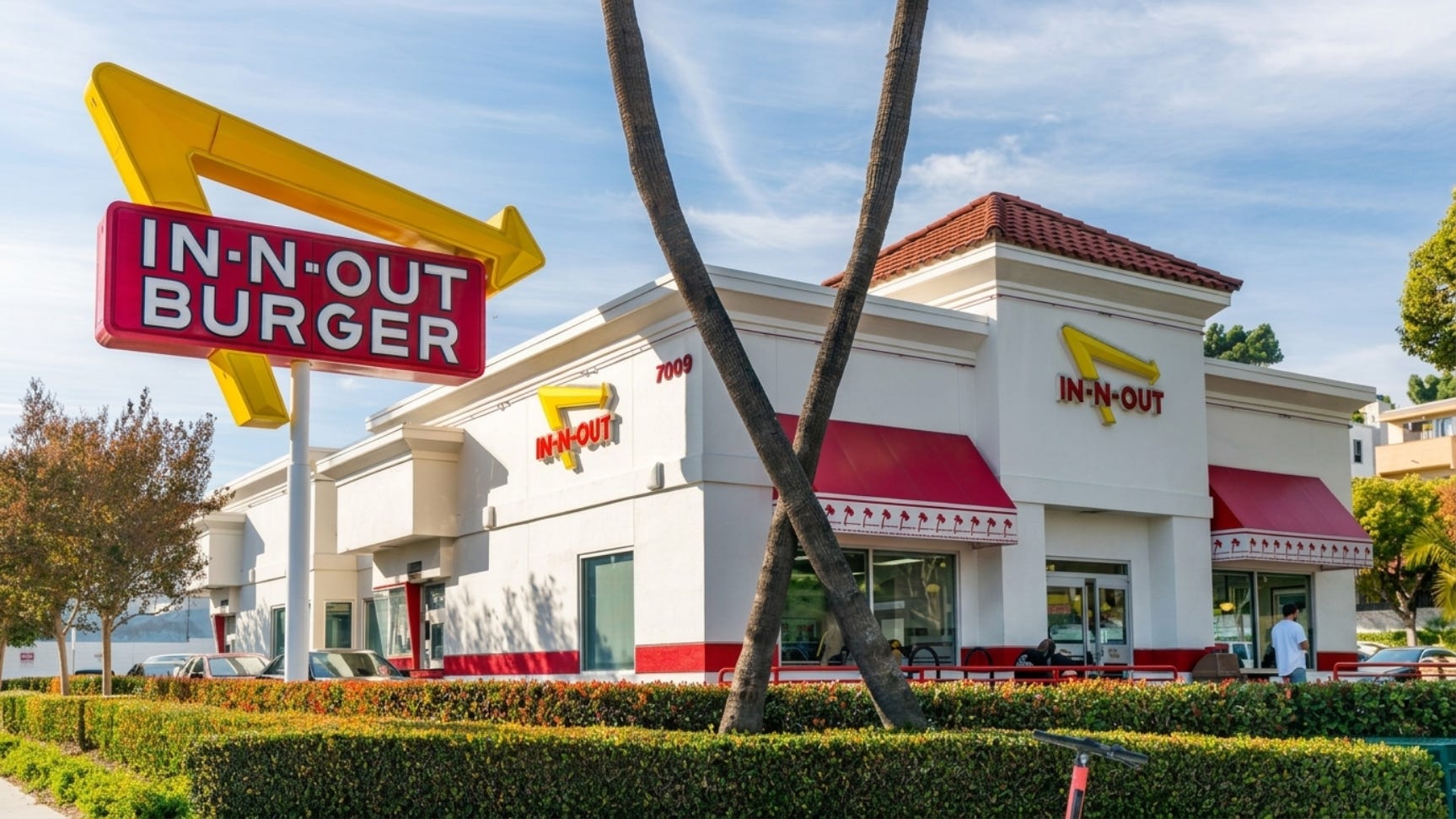
The comparison is obviously intentionally provocative, but the methodology is not merely a joke. SemiAnalysis included water consumed through cooling, power generation, and chip manufacturing, while restricting the restaurant comparison to blue water so the two figures were at least measuring the same general category. Its point was not that 346 million gallons is nothing. It was that even one of the largest AI facilities in the world looks very different once its water use is placed beside familiar economic activity rather than presented as an isolated, alarming number.
Of course, the obvious response is that hamburgers are food and AI is not. Food is useful, you see!
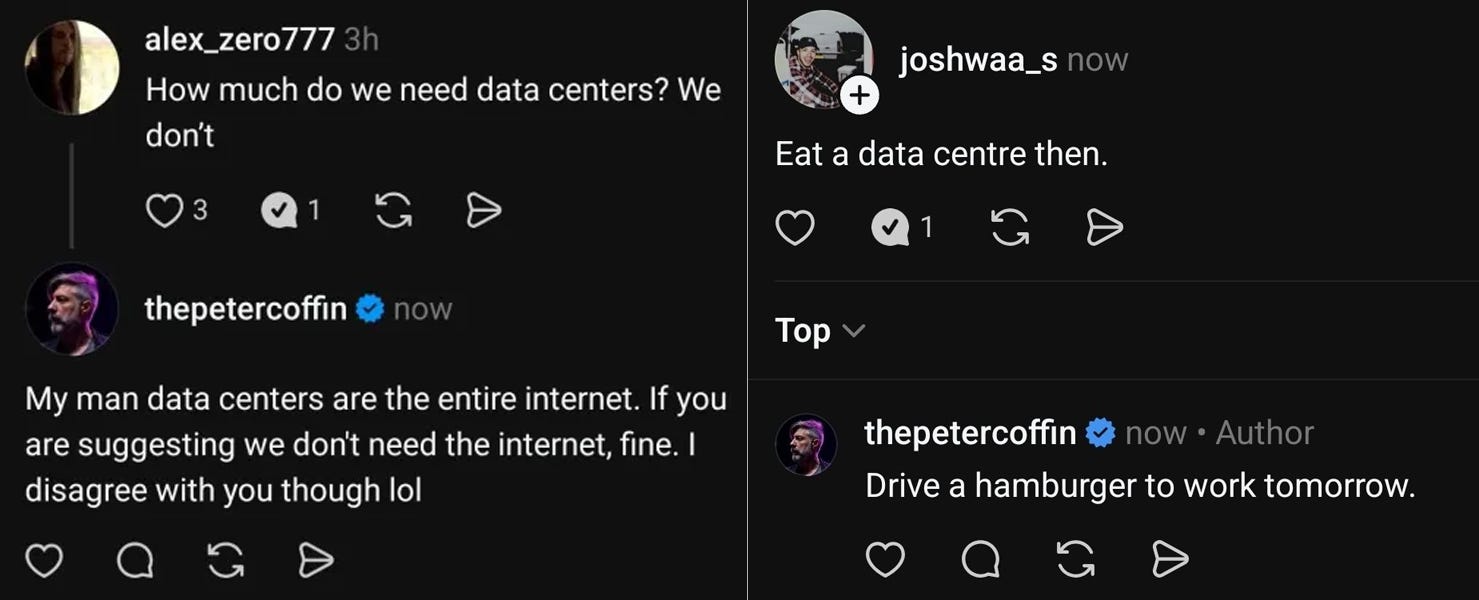
But usefulness was not the question. The chart compares water consumption. It includes alcohol and cigarettes, and apparently neither of them needs to be defended as socially necessary. In fact, we can easily argue these primarily produce harm, and yet where’s the outrage about their water consumption?
But the comparison is not claiming that these activities are morally equivalent or interchangeable; it is establishing scale. If the outrage is really about water consumption, then higher-consuming products should provoke at least as much concern regardless of whether someone considers them familiar, enjoyable, or useful.
The original question was how much water AI uses, and any attempt to move away from that is simply an attempt to move the goalposts.
Genuine Issues With Data Centers
This isn’t to say there are no real concerns about data centers!
They consume electricity, require land and infrastructure, can strain local grids, and may place serious pressure on water systems in particular communities. A facility using a relatively modest amount of water in global terms can still be badly located, poorly regulated, or disastrous for a municipality with limited capacity.
But that is just not the same argument. It’s not the argument being blasted everywhere on both social and traditional media. It’s not what your friend or relative will say at lunch. It’s not what leftists who are planting bamboo at construction sites are screaming about. Nor is it even a new problem!
A local water shortage does not prove that data centers are a major share of global water consumption. A badly designed cooling system does not invalidate an aggregate comparison. And the existence of legitimate reasons to oppose a particular facility does not mean every alarming claim about data centers becomes true.
In fact, collapsing these questions together makes those real, more specific problems harder to address. If a community has aging pipes, inadequate reservoirs, weak disclosure requirements, or officials handing out industrial permits without securing the necessary infrastructure, those are concrete failures with concrete solutions. They require regulation, transparency, and sometimes simply refusing to approve a project (which every municipality has to do before any of these things are built).
Instead, the discussion is routinely dragged toward the largest possible abstraction: data centers are “draining our water,” AI is consuming an incomprehensible share of the planet’s resources!
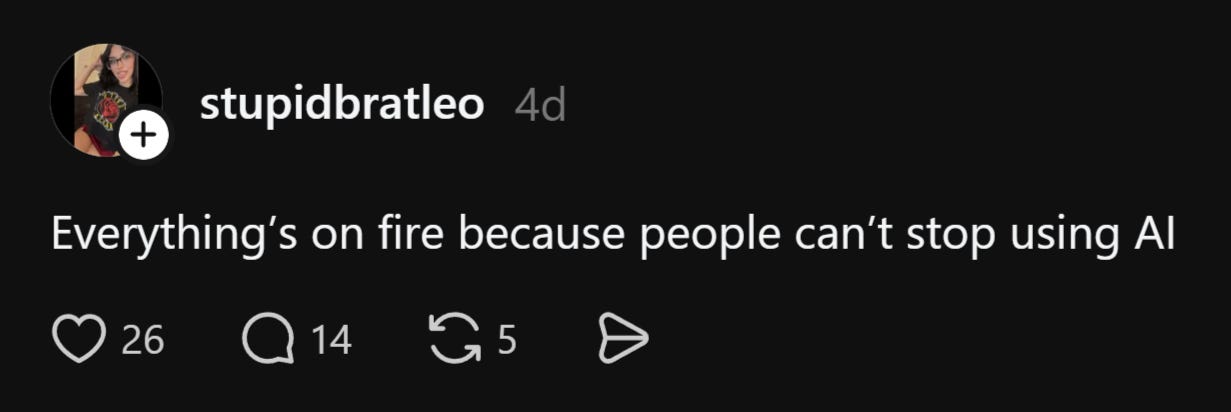
I think there is a very clear “Data Center Derangement Syndrome” on display here. It is not concern about data centers; concern is reasonable. We are seeing a total inability to keep the claim proportional to the evidence.
A citation date becomes proof that the data is obsolete. A local infrastructure dispute becomes evidence of global water scarcity. A comparison of quantities becomes a referendum on whether AI “should” exist.
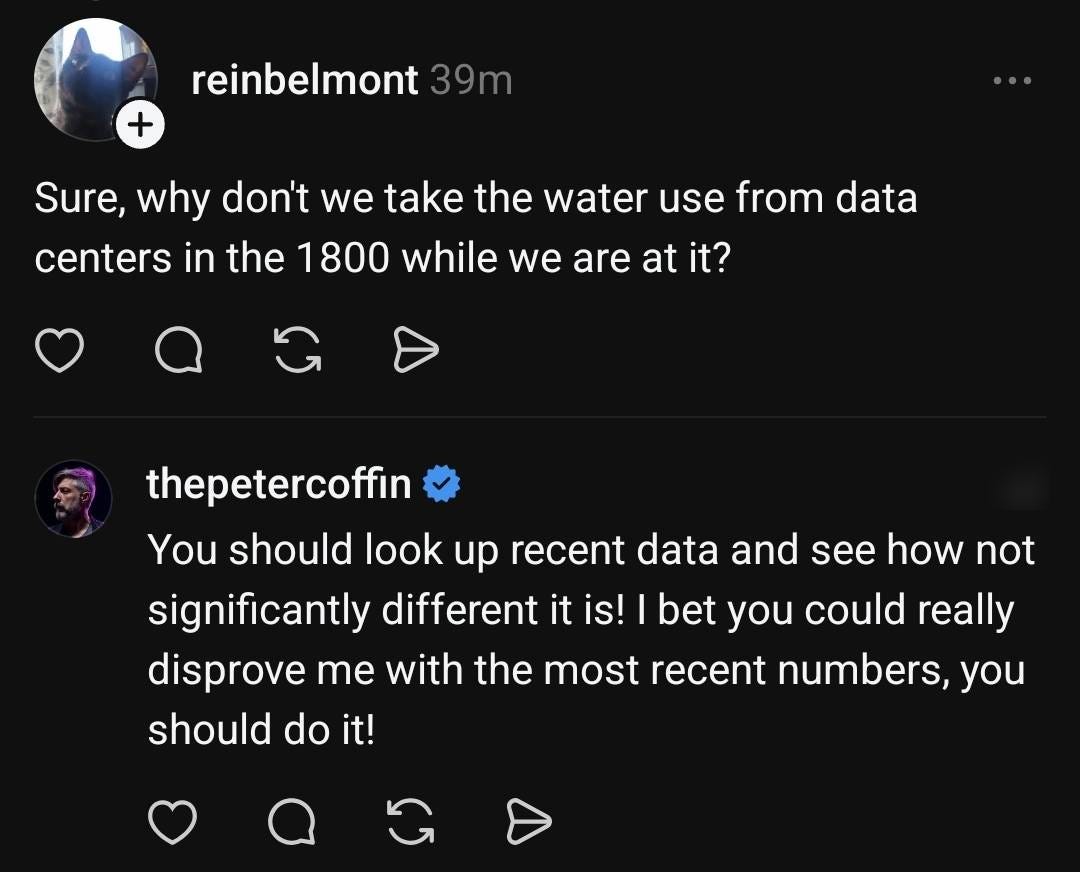
And when none of that is enough, the data centers become power stations for underground cities, cooling water becomes secretly diverted to bunkers, and ordinary redundancy planning becomes elite preparation for nuclear fallout.
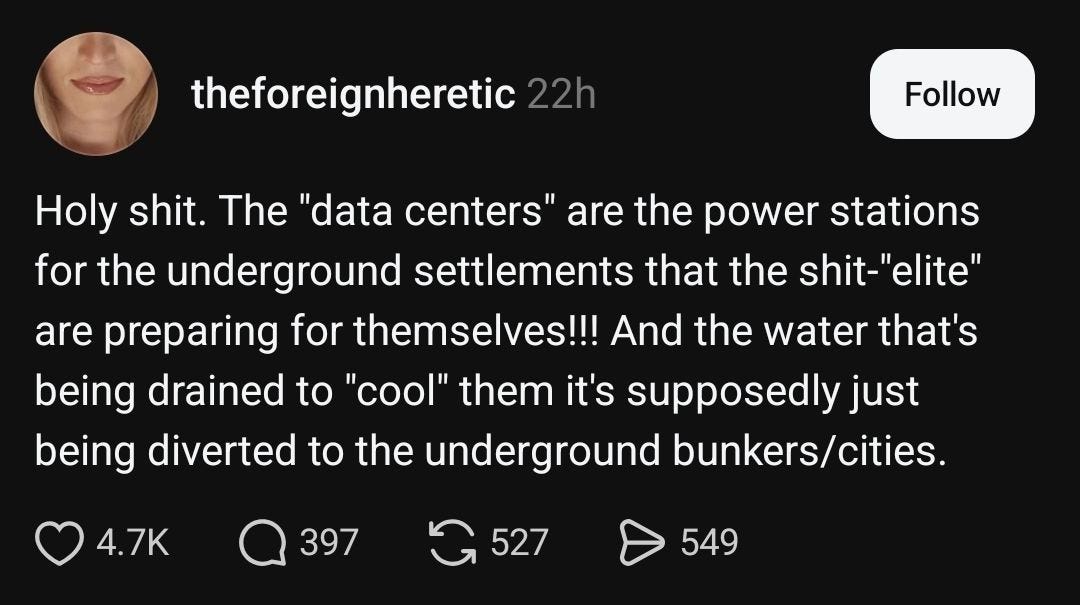
And before you say “that’s obviously a troll,” I looked at their profile, and it is most certainly not. This person is posting about everything from having a nice morning to how “Islamic terrorism is a CIA plot” (which I actually agree with until they make it anti-Semitic/not specifically anti-Israel). And even if it was trolling, people take it seriously:

The underground-city theory is an extreme example, not believed by most objectors to data centers. However, the crazier stuff rises as lines of thought that aren’t grounded in reality persist unchallenged.
The conclusion is clear: data centers are inherently sinister. Any data suggesting they are less harmful must be outdated, misleading, incomplete, or morally insignificant. Local issues are used as evidence of global disaster. Comparisons are dismissed because other activities are seen as more justified. When evidence no longer constrains the conclusion, there's no point where the narrative must stop.
Secret underground cities may sound absurd, but the idea is built from the same core elements as the more acceptable version of these fears: a threatening industrial site, unfamiliar technology, limited resources, unaccountable corporations, and a prior belief that far worse is happening than the evidence suggests.
Data centers are prime targets because they are large, costly, hidden, complex, and owned by mistrusted corporations. People see their high electricity and water use but don’t know what occurs inside. They are tangible yet mysterious, linked to AI, the current moral panic du jour.
Look Up
The true problem of data centers is who owns them, who decides where they are built, who benefits from them, and who is expected to absorb the costs.
A data center owned collectively and built according to public need would still use electricity and water. It would still require land, cooling, maintenance, and infrastructure. But those resources could hypothetically be allocated through some form of democratic planning, with the people affected having real authority over whether the project should exist, where it should go, and what conditions would govern it.
Under the current order, none of that is possible. The facility is built because its owners expect a return while local governments compete to attract it. Communities may be offered jobs, tax revenue, or promises of modernization, while the long-term risks are socialized. The data center’s usefulness is defined by profitability, and its costs are treated as unfortunate realities.
A “Data Center Derangement Syndrome” obscures this by turning the physical building itself (and anyone not openly hostile toward it) into the villain. The machines and water pipes simply become evil or, further, the cooling system becomes evidence of conspiracy. The fact that the facility is privately owned, publicly subsidized, and governed according to the interests of capital recedes into the background.
This is politically convenient, especially when the people spreading it believe they are being radical. A campaign that succeeds in stopping one data center does not alter who controls electricity, water, land, communications, or investment. It simply moves the project somewhere poorer, less organized, or easier to exploit!
Worse, the mythology encourages people to oppose the infrastructure without demanding control over it. They are taught to imagine the only alternatives as corporate data centers or no data centers, corporate AI or no AI, corporate technology or no technology. Ownership disappears from the argument, leaving only consumption and abstinence.
There is no discussion of China’s radically different approach to environmental sustainability, baking it into its AI infrastructure rollout (or its outlawing of AI-based layoffs). There is no discussion of other approaches like Lightchain AI, an attempt to convert blockchain tech into a means to decentralize computation while running open-source models (which theoretically forgoes the necessity for data centers, but at bare minimum provides an alternative, creating accountability).
Neither example needs to be treated as a perfect ready-made solution. The point is that capital-owned data centers are not the eternal form in which computation must be organized. Infrastructure can be publicly directed, geographically distributed, environmentally regulated, publicly owned, or built around entirely different priorities.
This is why the derangement is not merely embarrassing. It is disarming. It converts what should be a conflict over ownership and power into a moral panic over physical infrastructure.
Capital simply remains in control while its critics argue with buildings.
Conclusion
The problem is not that data centers should be beyond criticism. The problem is that they have become symbols onto which every anxiety about AI, capitalism, environmental collapse, and elite power is projected. Once that happens, evidence stops setting the limits of the argument.
Data centers are business. Business should be scrutinized. They should be regulated. They should be democratically accountable (or even publicly owned!). But it cannot be done via a deranged rejection of reality; instead, it requires structural analysis of what exists and what relationships are constituted around it.
People need to be able to distinguish between a global resource problem, a local planning failure, and a private ownership problem. We are not on the verge of defeating capital, but when we understand what it is actually doing, we are at least walking that path.
Your conclusion is correct and we're seeing the same problems with data centers as we have with other businesses at other times. For instance in Taylor, TX, a man, upon his death, left a generous amount of land to the city for a community park and they turned around and sold it to for 10million to someone that was going to build a data center. If this was 10 years ago Taylor would have turned around and sold it to some mixed-use real estate development company. Same problems different industry.