

Cope Bait

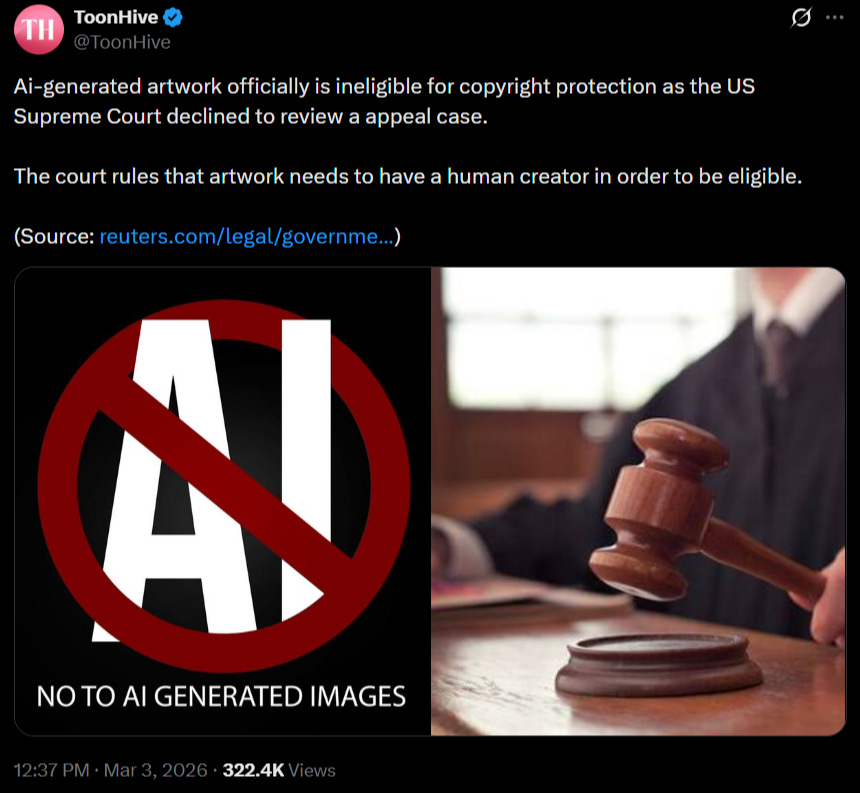
This post about the Supreme Court declining to hear the appeal in the AI copyright case mistakenly frames non-action as a sweeping victory.
It claims that “AI-generated artwork officially is ineligible for copyright protection” and presents the decision as if the courts have drawn a hard line against AI images. But the actual legal situation is exactly the same as the day before; the Supreme Court just declined to hear a case that would have challenged a precedent.
This is the kind of thing that spreads because it serves as cope bait—content that offers a symbolic win, allowing people to convince themselves that a perceived threat has been defeated. It is more important to feel good than it is to confront one’s problems, you see!
The impetus was a researcher seeking copyright registration for an AI-created image with no human author. The Copyright Office and courts rejected it, citing that copyright does not cover autonomous machine output. The celebration commenced!
So are AI models STEALING ARTISTS’ WORK, or are outputs not human-made? These ideas contradict each other, but contradictions don’t matter much when the point of the post is to circulate reassurance.
Reality, in that case, becomes a “yucking of the yum.”
Why Cope?
Obviously, we can see this kind of shit all over the internet for myriad different reasons. The AI subject is fascinating as an example, though, because these people want to do something that has never once happened before: stop technological progress.
Critics often argue that AI systems are “stealing” because they were trained on large datasets containing copyrighted images. The accusation is that the models are effectively copying or appropriating those works. That accusation is meant to frame AI output as derivative of the artists whose work appears in training data.
At the same time, the courts’ legal position is that purely AI-generated outputs cannot be copyrighted because they are not human creations.
So, again, the ruling being celebrated here produces an immediate contradiction: AI models are supposedly STEALING ARTISTS’ WORK, but their outputs are simultaneously being declared “not artists’ work.”
Those two claims cannot both do the work people want them to do. If the outputs are not regarded as authored works, they cannot meaningfully function as derivative works either. The legal framework needed to describe them as stolen property starts to dissolve the moment you accept the premise being celebrated.
But the contradiction doesn’t really matter, because the point of the post isn’t legal coherence. It’s reassurance.
This is cope bait.
None of this outrage is really about copyright doctrine. The courts simply reaffirmed something that has been true the entire time: copyright “protects” human authorship. Machines cannot have thoughts; thus, they do not need copyright “protection.” The Supreme Court's declining to hear the case simply upheld the status quo.
The anger surrounding AI art is really about a collapsing sense of creative scarcity. If anyone can generate a thousand images in an afternoon, the market advantage once attached to simply producing visual work disappears.
To someone emotionally invested in the bourgeois property paradigm, this feels like something has been taken away, even if nothing has actually been stolen. So the narrative must become flexible. AI is stealing artists’ work(!), at least until a court decision says the outputs aren’t even human creations. At that point, the contradiction simply becomes part of the coping mechanism.
Which is it? Are these systems producing derivative works built from stolen material, or are they producing outputs that lack human authorship and therefore fall outside the scope of copyright “protection” altogether?
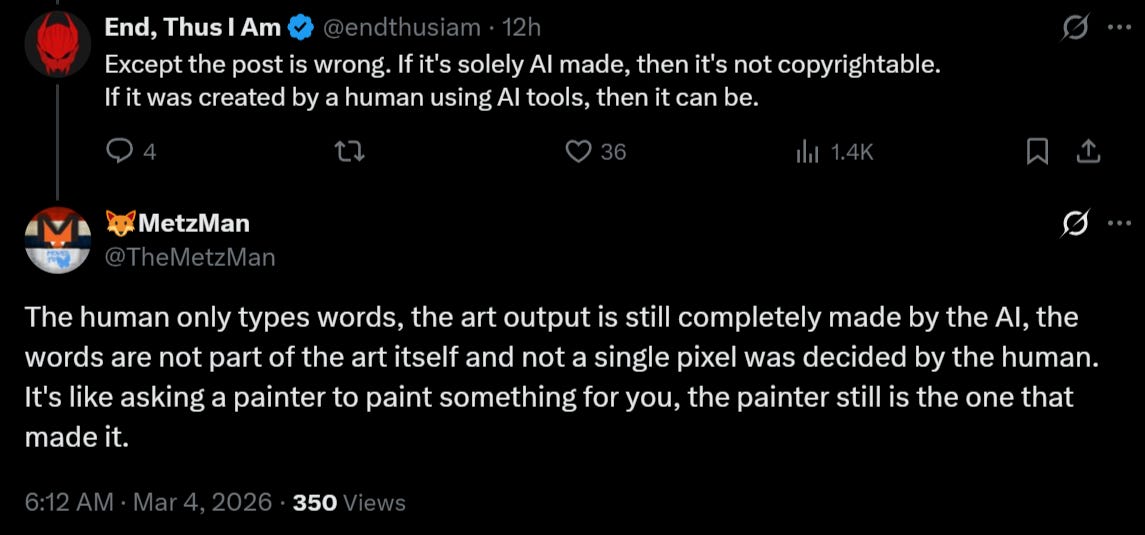
The people celebrating this ruling want to have it both ways, and the point isn’t consistency.
This turn again exposes the point I have been making the entire time: these people primarily value art as property. The instant they believe AI outputs cannot become property, they win! That’s all that needed to happen!
Living to Cope
Spend enough time observing people with very strong positions on issues they have no control over, and you start to notice a pattern. Every event becomes a victory or a defeat for someone’s ideological camp.
A leftist YouTube video announces that it’s “so over” for some conservative figure after a bad interview. A right-wing streamer declares that leftists have lost because of a scandal (like maybe a horse-related animated child porn one, ala Vaush, who is still enjoying a career for some reason). Every development is interpreted as proof that history is bending toward the side someone already believes in.
People want solutions and closure, but experience the world as unstable, confusing, and often hostile to their expectations. Ideological narratives step in to stabilize that feeling. Events must confirm that your side is winning and the other side is collapsing. When something threatening happens, a counter-narrative appears almost immediately to neutralize the anxiety.
Cope bait turns complex developments into symbolic victories. The narrative spreads because it resolves tension: the threat has already been handled, the system still works, and the enemy has already lost.
This brings us to the market solution for in-group/out-group: fandom.
Fandom turns ideological identification into a stable consumer relationship. Instead of simply believing something, you belong to a side. You follow the personalities, media outlets, creators, and narratives associated with that side. Your role is not primarily to understand events but to watch the ongoing story of your camp winning and the opposing camp losing.
In this piece’s context, fandom is the economic infrastructure of cope, and cope is one of fandom's reproductive functions. People are not simply coping with individual events; they are coping continuously. And that works really well for the advanced consumerism of contemporary capitalism.
People are organized into camps that fight with each other (rather than the class with power), and thus the ongoing task becomes maintaining the emotional stability of those camps. Events must be interpreted in ways that preserve and feed the narrative that keeps the group coherent. Our side is advancing, their side is collapsing, and history is moving in the right direction.
Coping has become a primary way people interpret reality. And thus, the incentive to investigate events has (carefully) disappeared. Stories that restore emotional equilibrium (the yum) are more valuable than an explanation that might destabilize it (the yucking).
Conclusion
Once you start looking for cope bait, it becomes impossible to miss. The AI copyright ruling is just one example of a much larger pattern: a complex development gets reduced to a symbolic victory so people can reassure themselves that the system still works.
The contradiction at the center of the celebration doesn’t matter because the narrative has already done its job. People who are living to cope are not trying to understand what happened. They are trying to restore the emotional stability of the story they already believe.
A little bookend: this is why some see me as a contrarian (linked video is one of my best and only 11 minutes… watch it). I am physically incapable of producing cope content, and that’s what the market wants.
Pretty much everything AI is trained on is copyrighted. So the argument is kind of insane as well. I want a copyright registration for something that AI stole from other copyrighted artists. The whole AI thing, is a shit show for sure. Thanks P , I always look forward to reading your articles.