

"AI Is Used in War!"
A claim that sounds meaningful but isn’t

In a recent New Yorker piece, “The Pentagon Went to War With Anthropic. What’s Really at Stake?”, the article makes specialized military systems sound like the same thing as the AI tools people use more and more every day.
The author takes the Trump administration’s push to have Anthropic remove restrictions on “all lawful uses” of Claude and turns it into a claim that they want to make it an “obedient soldier,” a phrase that immediately primes people to think the worst. The article returns to this phrasing multiple times, presenting it as a direct statement of intent:
“The Trump Administration wants Claude to act like an obedient soldier.”
“This government wants an A.I. that does not talk back, does not ask questions, and does not say no. It wants a perfectly competent and perfectly obedient soldier.”
- The New Yorker, (source)
Broader coverage has gone further, with the Iran war itself being labeled an “AI war,” turning the presence of AI systems into the defining feature. At the time of writing, the Wikipedia article on “AI Warfare” lists it as “the first AI war.”
These kinds of statements passively suggest that the tools people now associate with AI are deeply embedded in combat operations. That impression is rarely stated outright, but it is consistently implied, leaving the reader to fill in the blank.
Supposedly reputable outlets (The New Yorker is considered reputable, right?) are misrepresenting the facts. But even if they were entirely accurate, the fact that a technology is used in war doesn’t say anything meaningful about the technology itself.
An “Error”
The kinds of AI systems that actually operate within military pipelines are not conversational models. They are systems designed to process sensor data, identify patterns in images, and connect streams of information across different inputs. They have been in development and use for much longer than ChatGPT and Claude, and they do not resemble the tools that dominate public discussion of AI.
A useful corrective to this can be found in “Kill Chain,” a piece from Artificial Bureaucracy, in which the author goes out of their way to clarify that the systems in question are not large language models and are not used for combat operations in the way people often imagine.
That clarification is not a minor technical detail. It points to something more fundamental: the systems being described are not new in the way they are being presented.
Militaries have long used systems that aggregate sensor data, track objects, and calculate actions based on defined parameters. These systems have gone by different names over time, but they have been part of military infrastructure for decades. What has changed is not their existence, but how they are labeled and discussed (as “AI”).
During the Cold War, systems such as the Semi-Automatic Ground Environment (SAGE) integrated radar data across large regions to track aircraft and guide real-time interception decisions. Later systems extended this approach across satellites, communications, and battlefield coordination.
There is a long (frankly terrifying) list of similar technologies that have been developed and implemented, but describing them as “AI” makes them seem new, rather than as the current iteration of stuff that’s been around since long before I was born.
The Claim
Even if that distinction is made, the broader claim that “AI is used in war” still does not carry much weight on its own. It describes presence, not function.
War does not exist outside of society. It depends on the same infrastructure, tools, and systems as everything else. Electricity is used in war. The internet is used in war. Medical equipment is used in war. Their use in war tells us nothing about those technologies.
Similarly, AI exists in a significant capacity outside of war—just ask “people with good taste” about it. It’s used to manage power grids (decreasing power use in more and more applications), medical systems, logistics, and supply chains. None of these things are inherently military functions. It’s just normal shit that we need.
That infrastructure is used by militaries because they exist in the same world as everything else. Energy, transportation, and communication do not fundamentally change when used in a military context. “Military energy, military transportation, and military communications” are the same things, just in a different context.
Unfortunately, it is not up to the wee folk to decide whether we have militaries and war, but I don’t understand, say, being angry at municipal water because the tech could be misused somewhere.
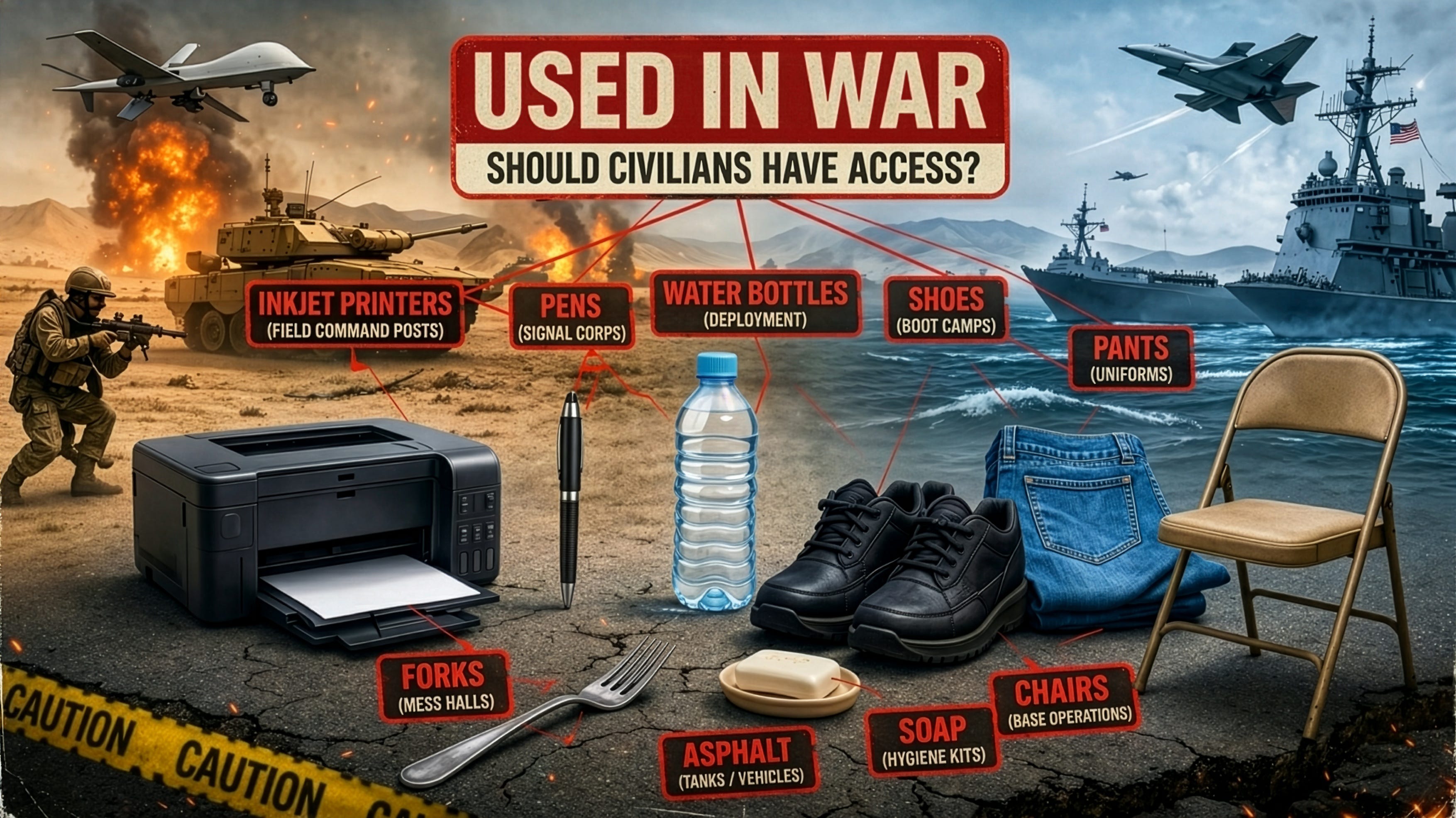
This argument is basically “things used by the military shouldn’t be allowed in civilian life.” Should that apply to inkjet printers? Pens? Shoes? Pants?
Water is used in war. Should we ban water? Air?
I don’t think I need to come up with more examples to illustrate how stupid this point is. If your standard is that something can be used in war, then you haven’t identified a problem. You’ve just described the world. The world isn’t allowed!
The Confusion
Part of why this keeps happening is that “AI” no longer refers to anything specific. AI has always been a marketing buzzword; the thing that really made “AI” ubiquitous was LLMs and generative models, which are more or less “machine learning” and, if we are being technical, probably shouldn’t be called “intelligence” of any kind, artificial or not. Generative models have exploded in popularity and use, making it beneficial to use the term “AI,” thus, what is already a loose, untechnical application of language is incentivized to mean basically anything that is technology and for sale.
Before that, “algorithm” was the buzzword, and much of what falls under the wide purview of “AI” previously could fall under the “algorithmic” umbrella. “AI” was a buzzword in video games from the late 90s to the mid 2010s, and fell off amid a general decline in specificity in gaming, which happens cyclically in most creative industries (it’s related to “soulless” art).
To be frank, the “AI” the military is using is similar to the “AI” that reads oxygen sensors in your car’s air intake and catalytic converter, and adjusts fuel-to-air ratios. Most of what’s being called “AI” is just systems processing inputs and producing outputs, not agents making decisions as many imagine.
When it became a catch-all term, the distinction between processing inputs and making decisions disappeared, replaced by a vague sense that “AI is involved.” This is made worse by the way these systems are described by so-called “reputable” media outlets. Phrases like “AI war” or “obedient soldier” do not clarify what is happening; they confuse it.
And they do so both at the behest of some individual author’s personal whims and at the behest of media corporations with embedded interests in how these various technologies are perceived. An author who doesn’t like AI is a great asset to a media company trying to establish precedents (legal and ethical) for its use, to attempt to lock it down in service of the IP cartels.
Conclusion
What’s being presented as a major revelation (that AI is used in war) turns out to be a combination of misrepresentation and a categorical mistake.
On one level, the systems being described are not what people are being led to imagine. They are not new and are not operating as autonomous agents. On another level, even if they were exactly as described, the fact that a technology is used in war should not meaningfully impact our opinion on the civilian usage (oh, hi there, nuclear power).
The confusion persists because the term “AI” has become elastic enough to absorb whatever meaning is convenient in the moment. It can refer to a chatbot, a targeting system, a logistics optimizer, or a feedback loop in a car engine, and that ambiguity allows people with agendas to frame many different things in many different ways.
People fear AI itself misleading them, but “reputable” media companies have been doing that the whole time.
Was this written with AI?