

AI Is Profitable. So… Does That Make It Good Now?
"Socialists" critiquing AI as a money hole are not only arguing FOR capitalism, but they aren't even doing it right


For years, the loudest online critics of AI (most often leftists/supposed socialists) have repeated the same claim: “AI is massively unprofitable; it only exists because Silicon Valley is lighting money on fire!”
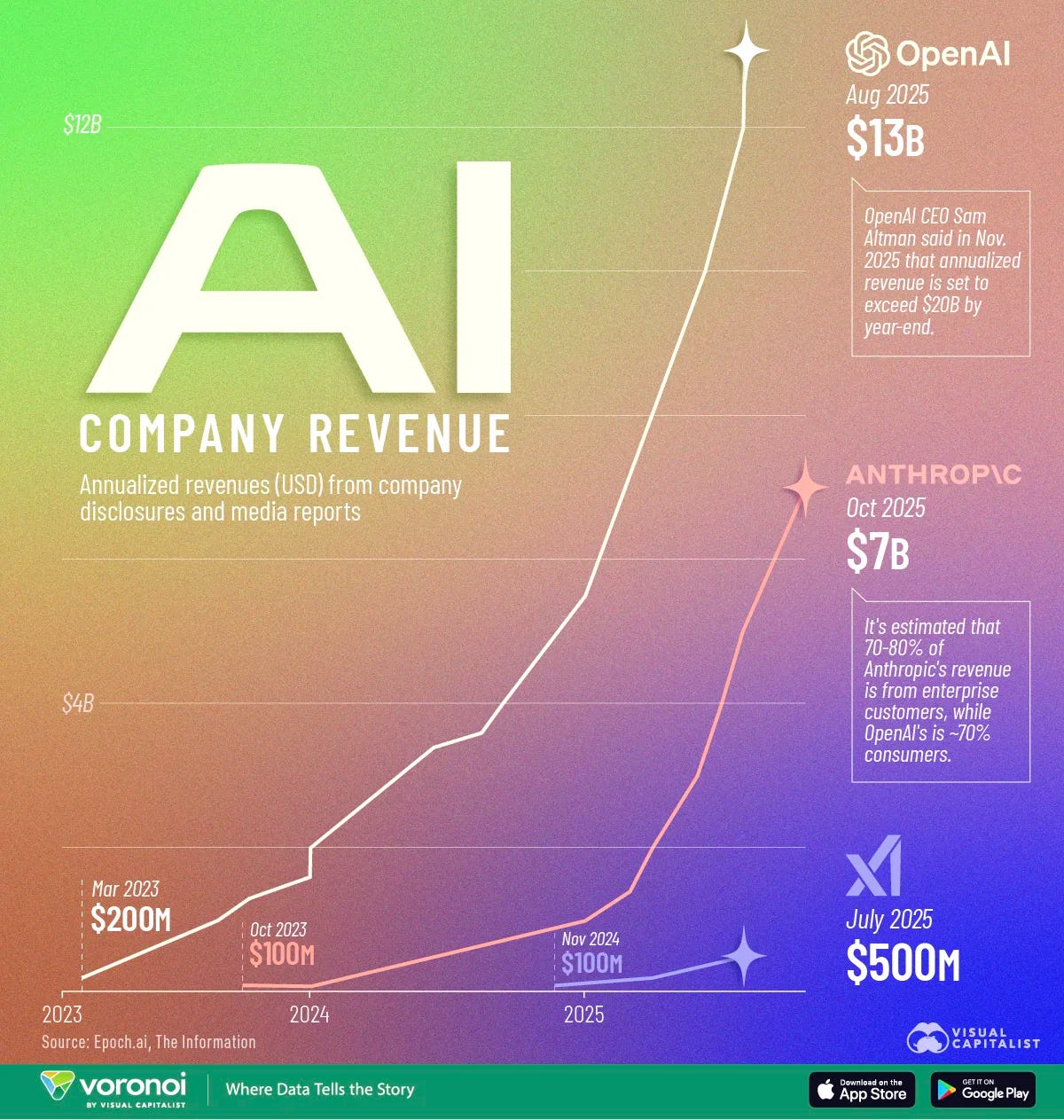
It’s become a pillar of the anti-AI argument. The easy problem to point out is that it isn’t actually true. Goldman Sachs considers OpenAI “marginally profitable on inference,” AI-driven cloud revenue is exploding for Microsoft and Google, and Visual Capitalist shows OpenAI’s run-rate revenue passing $13 billion. Further, you don’t mark capital expenditures on a P&L sheet; that’s not “a loss.”
But whatever else you want to say about AI, “nobody is paying for it” is simply not a material analysis of what’s happening.
But here’s the more interesting part: if profitability is your critique, what happens when AI becomes (more) profitable? If the argument is “AI is bad because it doesn’t make money,” then the inverse is baked into the logic: AI becomes good the moment it does.
So is AI good now, “socialists”?
The Unprofitability Meme
As I said, a particular story about AI has hardened into “common sense” among online leftists and “socialist-populist” creators.
“AI is massively unprofitable! It only exists because Silicon Valley is lighting money on fire! It’s a bubble propping up GDP with fake numbers as a handful of companies pass money back and forth!”
But it’s not just Breadtube and “socialists” living in Brooklyn or in/around DC with large Patreons saying this. It’s now coming from people who are very consciously trying to incorporate a kind of “left-ish, working-class champion” tinge to their polished, brand-safe, mainstream creator aesthetic. Drew Gooden is a perfect example.
His recent video, Greed Is Destroying the World, is basically that lane in pure form: high (but not too high) production value, NordVPN ad read, some light “I’m just a guy” self-deprecation, plus a big story about inequality, tax policy, FDR, and the destruction of the American middle class. It’s not framed as “socialist,” necessarily, but he’s clearly trying to gesture in that direction; New Deal history, top tax rates, shareholder value, “we need class solidarity,” etc.
I actually left a comment on the video that didn’t mention AI. My point was simple Marxism: the problem isn’t “greed”; it’s the structural contradiction in which workers are never paid enough to buy back the full value of what they produce. The nicest capitalist in the world still has to participate in that logic. “Greed” is a moral confusion that actually deflects from the material problem.
But eventually, Drew gets to his recent favorite punching bag: AI. See, AI is the latest expression of rich-guy greed, fundamentally fake and unprofitable(!).
“The only reason we’re not technically in a recession is because the GDP is still going up. But the only reason the GDP is still going up is because of the AI industry, but the only reason that even looks as good as it does is ’cause a handful of companies are just like passing money back and forth… Worst case scenario, it’s all bullshit, the bubble pops… Best case scenario, a few billionaires get even richer.”
This claim is economically illiterate. The United States has a roughly $30 trillion (TRILLION) GDP. Total U.S. cloud revenue across all providers lands somewhere around $350–400 billion, and AI-specific workloads are just a fraction of that.
OpenAI’s entire run-rate revenue is about $13 billion; Anthropic’s is around $7 billion. These are huge corporate numbers, but on the macroeconomic scale? Not so much.
AI isn’t “single-handedly propping up” GDP (NOTHING IS); it’s barely even visible at that scale. Consumer spending, services, manufacturing, construction, and government expenditure dwarf AI by orders of magnitude. Saying AI is the only reason GDP is going up is like saying “the economy is being held together by one moderately successful mid-tier corporation.” On this scale, Amazon and Walmart don’t seem nearly as significant as they do on pure visibility alone. It’s just not how any of this works!
From there, he pivots into data centers, electricity usage, water waste, local subsidies, and how ordinary people end up footing the bill. All of which is fair to be angry about. But notice what gets smuggled in as a background premise:
AI is fake value. AI is unprofitable. AI is just a bubble that either explodes or quietly fattens billionaires.
That framing is everywhere now. Drew isn’t inventing it; he’s picking up a meme that’s been bouncing around online-left circles for a while. It feels anti-corporate, so it gets repeated without anyone checking whether it’s true.
And then, just to complete the 2010s Liberal YouTube bingo card, he ends a video ostensibly about class and inequality by randomly shitting on gamers. There’s a throwaway bit about arguing on Reddit over hating “woke” games because the main character isn’t a sexy enough lady. It’s minor in isolation, but it fits the post-Gamergate reflex where “gamers” are treated as the natural cultural enemy. For a video that’s supposedly about class solidarity, it’s a weird choice to casually dunk on one of the few mass hobbies that still cuts across class and geography. But that’s the default now: the villain is “gamers,” not capital.
Cultural signaling (pandering) aside, as I have pointed out (links in the intro!), the numbers actually show that the primary claim is not valid.
According to a UK investment trust summarizing Goldman Sachs research, OpenAI is already marginally profitable on inference—around $4.29 of revenue per million tokens versus $3.36 in cost per million tokens. Thin margins, yes, but that’s still profit (not “every prompt loses money!!”).
OpenAI itself has gone from effectively zero to a $13 billion+ run rate in just a couple of years, with Visual Capitalist charting its revenue curve alongside those of Anthropic and xAI.
Meanwhile, this supposedly “fake” AI sector is showing up very concretely in cloud earnings. Microsoft’s Azure and other cloud services grew around 39% year-over-year, helping drive roughly $75 billion in Azure revenue for FY 2025. Google Cloud pulled in $15.2 billion in Q3 2025 alone, up 34% year-over-year, with Alphabet explicitly crediting AI infrastructure and services for the surge.
Massive amounts of very normal, very boring enterprise money are flowing into AI-powered cloud products and APIs. That doesn’t mean OpenAI or Anthropic as whole companies are wildly profitable, but it absolutely does mean the “every token is a money bonfire” line is fucking nonsense.
So where does the “massively unprofitable” myth come from?
A big part of it is fundamental accounting confusion. People look at tens of billions being spent on data-center build-outs, GPUs, and power, and they call that “losses.”
But that spending is capital expenditure (CAPEX): you build the factory once and use it for years. The same way nobody in 2010 said “AWS is unprofitable” just because Amazon was pouring money into new data centers, you can’t look at the AI infrastructure binge and treat every dollar of CAPEX as proof that the underlying business model doesn’t work.
The other part is the very real story Drew focuses on: externalized costs and socialized risk.
Local communities are paying higher power bills, losing water, and absorbing noise and land-use damage so that hyperscalers can run AI workloads. Municipal governments are cutting deals and offering subsidies to attract or keep those facilities. Those are legitimate problems.
But they’re not proof that AI is unprofitable, which is the critique he is making, which frankly entirely undermines the framing of his video that greed is ruining the world. Because if they’re not building it to profit, where are the numbers to claim “greed”?
If anything, they show the opposite: the business case is strong enough that states and utilities are willing to bend over backwards to host the infrastructure, and strong enough that companies are comfortable front-loading a gigantic amount of investment at the expense of regular people (later, we’ll talk about why this makes profitability a stupid critique of any business from a left-populist/socialist perspective).
So if AI isn’t “massively unprofitable,” why is the left so attached to the idea that it is?
Material Interests And Useful Idiots
Why has this become one of the loudest and most durable talking points in YouTube-left orbit, especially among creators trying to signal a kind of populist-left sensibility without ever actually engaging with political economy?
The simplest answer is that the unprofitability meme feels anti-corporate.

It gives people the emotional satisfaction of imagining they’re exposing hype or calling out billionaires for subsidizing their own delusions.
But profitability is a capitalist metric. If your entire argument is “this thing is bad because it doesn’t make money,” you’ve already accepted that making money is the standard by which things should be judged. You’re arguing on the terrain that capital chose. Worse, you are arguing from and for capital’s perspective!
We’ve seen this exact mistake before. During the AI-art/IP moral panic driven by the post-Somerton Breadtube freakshow, many online-left figures became the most extreme copyright hawks on the internet, defending the very same IP-maximalist worldview that Hollywood, Disney, and major publishers have spent a literal century lobbying for. A group that claims to be anti-corporate ended up repeating corporate definitions of theft, corporate fantasies about “style ownership,” and corporate desires to lock down every derivative work. Now the same thing is happening again, only instead of doing PR for the entertainment industry, they’re doing it for Microsoft, Google, and Amazon.
These corporations absolutely fucking love the unprofitability narrative. When Sam Altman or Sundar Pichai talk about how wildly expensive AI is, they’re not confessing; they’re messaging.
If AI seems barely (or not) viable, politicians are more likely to shovel subsidies into data center construction, grant favorable land deals, subsidize power costs, or treat private infrastructure as a public responsibility. Crying poor is a tried-and-true maneuver for every major U.S. industry. It greases the skids for public subsidies of private investment and makes regulators less aggressive. No regulator aggressively prosecutes a sector that’s framed as fragile, unprofitable, or unestablished.
For emphasis: “we’re losing money” is a great way to avoid antitrust heat while consolidating power.
There’s also competitive deterrence. If the public believes AI is prohibitively expensive and fundamentally unprofitable, then smaller labs, startups, and open-source efforts are discouraged from even trying. Why enter a market if only trillion-dollar companies can (or even can’t) afford the losses? The meme functions as a moat. And again, online-left creators repeat this narrative verbatim, thinking they are criticizing the industry when they are actually reinforcing the very story the industry wants told.
Underneath all this is the deeper structural problem: the online-left ecosystem has become almost entirely reactive. It defines itself not by any coherent materialist analysis but by a vague sense of antagonism toward whatever tech CEOs are doing at a given moment. That creates a predictable pattern. A corporation pushes a narrative. People reject it, but in doing so, refuse to interrogate its logic. Instead, they invert the corporation’s talking points, but the negation only reinforces the frame.
This brings us back to Drew’s video. His framing is built on righteous anger and social-democratic nostalgia, but when he gets to AI, he’s not offering political economy. He’s repeating the capitalist narrative he thinks he’s opposing. He’s mad at the wrong thing for the wrong reason. Instead of asking the material questions (who owns the compute, who controls the infrastructure, who extracts the rents) he talks about profitability. And that is exactly where the contradiction emerges.
If profitability is the critique, then profitability becomes the justification.
The Contradiction
Again, if your critique of AI is that “it isn’t profitable,” you’ve accepted the premise that profitability is the standard by which the value of a technology is judged. Congrats! You have the same standards as Elon Musk.
People who identify as socialists/leftists should not need this spelled out, but here we are: profit is not a systemically critical metric. Profit tells you nothing about power, ownership, class composition, or long-term structural effects. It only measures capital accumulation.
And this is where I want to be extremely clear: I distinguish completely between AI as a technology and AI as a business.
AI represents a horizon of possibilities we haven’t had access to before: the ability to automate cognitive labor, scale expertise, and potentially move toward something closer to “fully automated luxury space communism” (or whatever you want to call “accessible post-scarcity”). That is a technological or civilizational horizon, not a business one. I am enthusiastic about the tech while having no affection whatsoever for the corporate, profit-driven apparatus currently building it.
Which brings us back to the profitability argument. If your “AI is bad” argument is dependent on AI “not making money,” then the moment it does make money, either your objection evaporates (and you concede), or you show everyone that you’re an opportunist. This is an argument built on a foundation that capital controls entirely. They are the ones who get to publish the numbers. They are the ones who get to frame the margins. They are the ones who get to decide when to tell you the business is now “sustainable,” “successful,” or “profitable.”
It’s the same shit we’ve seen regarding IP. The moment you accept the corporation’s vocabulary (“theft,” “ownership,” “style,” “profitability”), you are no longer critiquing capital; you’re playing by their rules!
Meanwhile, again, the actual political-economic questions go unasked: who owns the compute? Who controls the infrastructure? Who sets the price floor for access to intelligence? Who is subsidizing the build-out? Who bears the environmental and local burdens? Who captures the rents once the frontier consolidates?
These are the questions that determine whether AI becomes a public utility, a privatized extraction engine, or something in between. These are the questions an “anti-capitalist” should be asking, and the ones they consistently avoid by instead trying to pwn AI companies with “gotcha” claims about profitability and theft.
The part that should embarrass those repeating this narrative: As I linked at the start, AI is already profitable on a per-unit basis, with revenue rapidly increasing. They've trapped themselves in a position that reverses as soon as the quarterly figures shift.
If you believe profit is the measure of value, then you must accept what profit implies. You can’t swap in capitalist logic when it flatters your position and then pretend to reject capitalism afterward. If you insist that AI is bad because it loses money, then yes, you are forced to admit that it becomes “better” as it starts making money. And it is making more money exponentially.
The left cannot critique what it doesn’t understand. To understand socialism, or even have any real ideas about it, one must understand the fundamentals of capitalism. And they don’t.
If your standards are capitalist, capital will always win!
Conclusion
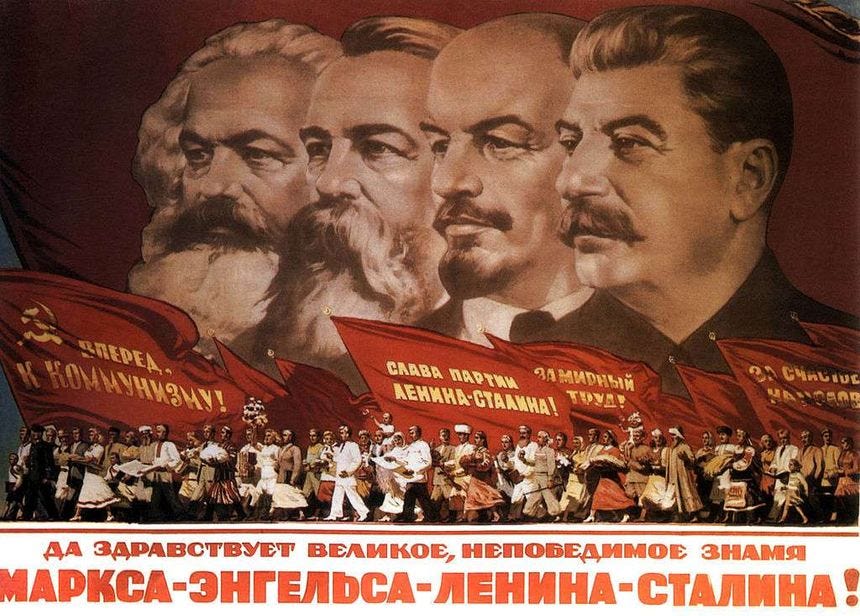
None of this is an argument that AI companies are good. I’m saying the way the left talks about this stuff makes it clear they do not understand even the basics of anything any of those heads on the head thing said. I am not asking for people who read this to know every word these dudes said, but I am asking why the self-appointed left seems to know none of them whatsoever.
These people straight-up do not understand what they are for, and they do not understand what they are against.
If you’re angry about AI, be angry that public money and public resources are being used to build private business. Be angry that ordinary people are being made involuntary investors in infrastructure they don’t own and can’t direct. Be angry that we’re letting a potentially civilization-changing tool be hardwired, from day one, to serve shareholders instead of everyone else.
Those are material critiques. “It’s not even profitable” is not.
it's gonna be really funny if anti-AI idiots realise the big survivors of the Dot Com Bubble have been building huge and somewhat wasteful data centres for decades now so they go full-on anprim
Yep, that video Drew made, oof cringe.
This is based on populism and vague gesturing, what badmouse calls "baby leftism" i call it vulger Marxism regardless the adultism.
Along with that ip argument approach immanual kants greatest misery for everyone, so it's lower than even doomers I respect; its miserablist. Even with my sympathys with deontology.